Blog

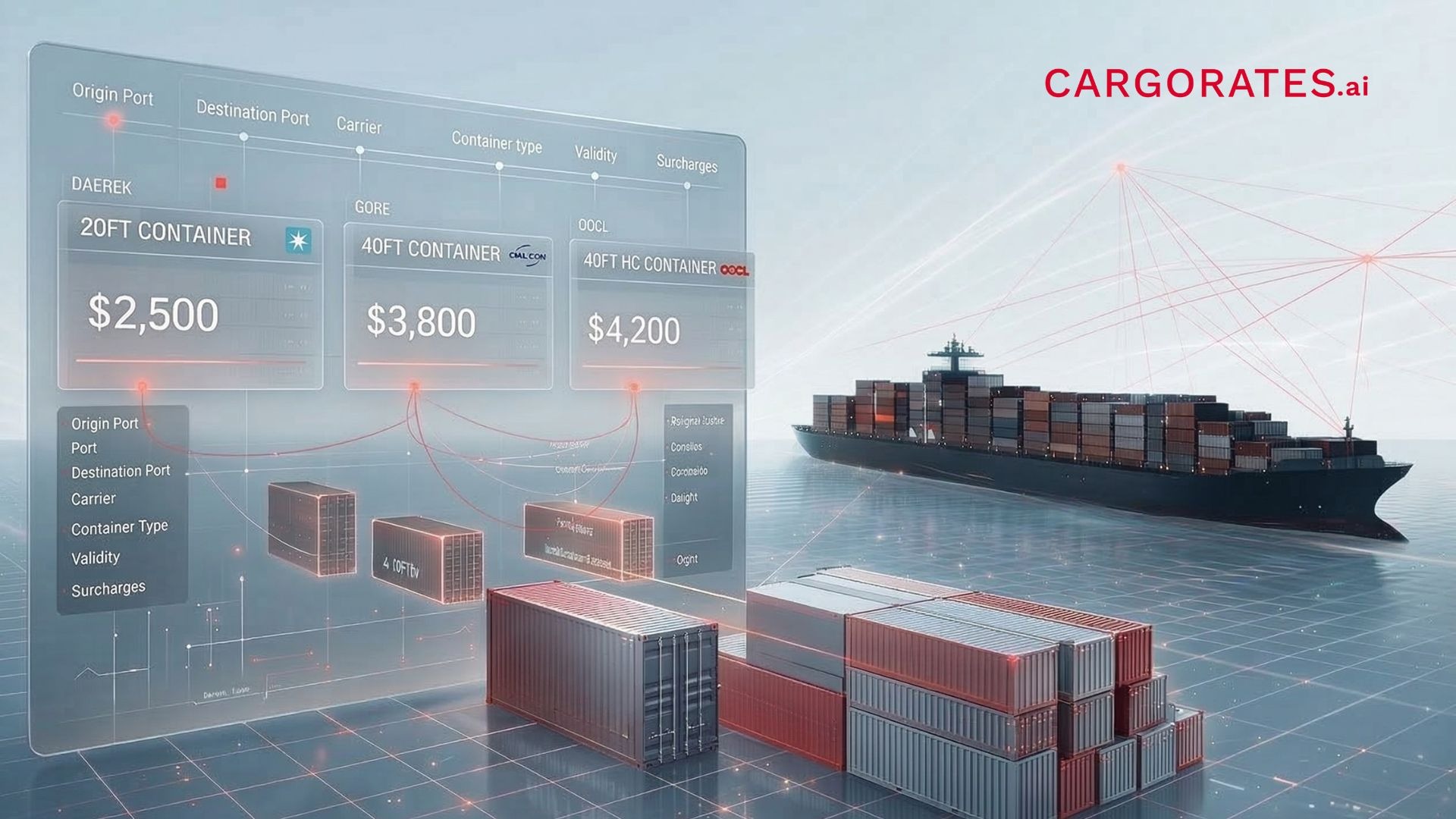
FCL rate management is the process by which NVOCCs, freight forwarders, and BCOs structure, store, govern, and apply Full Container Load carrier pricing across trade lanes and container types. It covers the organisation of 20-foot and 40-foot container rates from multiple carriers, surcharge management specific to FCL shipments, validity and version control across contract amendments, and the application of correct FCL pricing at the moment a quote is generated.
For organisations that move significant container volumes, FCL rate management is where quoting speed and margin accuracy are won or lost. Structure it correctly and the platform does the work: every rate is current, every surcharge is present, every quote is generated in seconds. Structure it incorrectly and every FCL quote requires manual rate hunting, surcharge cross-checking, and margin calculation, which is what turns a two-minute quoting process into a two-hour one.
This guide covers the full FCL rate management lifecycle: what FCL rates require structurally, how they differ from other freight rate types, where the operational challenges concentrate, and how each stage of the process functions on a platform built to manage it. The operational context throughout draws from how NVOCCs and freight forwarders manage FCL rates on Cargorates.ai.
FCL rate management refers specifically to the pricing governance of container-level ocean freight. An FCL rate is priced per container, not per unit of weight or volume, which fundamentally shapes how rates are structured, stored, and applied compared to LCL or air freight pricing.
In practice, FCL rate management involves five interlocking operational processes:
As established in our complete guide to ocean freight rate management, the operational failures in most freight organisations do not happen at the rate sourcing stage. Carriers send rates. The failures happen at structuring, application, and governance, which is precisely where FCL rate management is most demanding.
The distinction matters operationally because FCL and LCL rates cannot be managed using the same logic. Understanding the difference makes clear why FCL rate management requires its own specific structure within any rate management platform.
| Rate Attribute | FCL (Full Container Load) | LCL (Less than Container Load) |
|---|---|---|
| Pricing unit | Per container (per box) | Per CBM or weight-tonne, whichever is greater |
| Container types managed | 20ft, 40ft, 40ft HC, 45ft, reefer, OOG, each with its own rate | No container type differentiation at the rate level |
| Primary management challenge | Container type segmentation, carrier version control, allocation tracking | CBM/weight logic, CFS charges, consolidation lane coverage |
| Surcharge profile | BAF, PSS, THC, CAF, GRI, D/F applied per container | BAF, PSS, CFS, THC applied per CBM or per shipment |
| Volume tracking | TEU allocation tracking against contracted volumes per carrier | No allocation tracking, priced entirely on demand |
| Quote construction complexity | Container type selection, multi-carrier comparison, schedule matching | Volume/weight calculation, CFS inclusion, consolidation routing |
FCL rate management is not inherently more complex than LCL, but it requires a structurally different approach: container type segmentation at the rate level, TEU allocation tracking against carrier contracts, and a clear system for managing the multiple rate versions that arise from quarterly contract renewals and mid-cycle carrier amendments.
Effective FCL rate management begins with structuring rates correctly at the point of entry. An FCL rate stored without the right attributes cannot be queried accurately at quote time. The following data points must be captured for every FCL rate entry in any platform claiming to support professional container rate management:
| Rate Attribute | What It Defines | Why It Matters at Quote Time |
|---|---|---|
| Origin and destination port pair | The specific trade lane this rate covers | Ensures the rate is returned only for the correct lane |
| Container type | 20ft, 40ft, 40ft HC, 45ft, reefer, or OOG | Prevents a 20ft rate from being applied to a 40ft HC shipment |
| Carrier | The ocean carrier this rate was negotiated with | Enables multi-carrier comparison on the same lane |
| Validity period | The start and end dates during which this rate is usable | Prevents expired rates from appearing in quotes |
| Base linehaul rate | The rate amount in the applicable currency | The foundation of the quote before surcharges and margin |
| Surcharge profile | BAF, PSS, THC, CAF, and GRI values applicable to this carrier and lane | Determines the total cost presented to the shipper |
| Allocation limit | TEU commitment against this carrier under the current contract | Prevents over-booking against a contracted allocation |
| Contract version | The amendment identifier for this rate sheet | Ensures teams always quote from the current contract version |
| Margin rules | The markup applied to this lane, carrier, or customer segment | Ensures profitability is applied consistently without manual calculation |
Capturing all of these attributes at the point of rate entry is what makes FCL rate management scalable. When even one attribute is missing, the downstream consequence is a quote that cannot be fully automated, a surcharge that gets missed, or a margin that must be applied manually. Each of these gaps adds time to the quoting cycle and risk to the final invoice.
FCL surcharges deserve specific attention because they are responsible for the largest share of quoting errors and invoice disputes in container freight operations. A baseline haul rate without surcharges is not a usable rate. It is a partial price that will be corrected at invoice time, and that correction is what generates friction with shippers.
The surcharges that must be managed as part of every FCL quote include:
| Surcharge | Full Name | How It Applies to FCL | Frequency of Change |
|---|---|---|---|
| BAF | Bunker Adjustment Factor | Applied per TEU or FEU based on fuel indices for the trade lane | Monthly |
| PSS | Peak Season Surcharge | Applied per container during high-demand windows, typically announced 30 to 60 days ahead | Seasonal |
| THC | Terminal Handling Charge | Applied per container at origin and destination ports, varies by port | Periodic |
| CAF | Currency Adjustment Factor | Applied as a percentage of the base rate on exchange-rate-sensitive trade lanes | Monthly or quarterly |
| GRI | General Rate Increase | Carrier-wide rate adjustment applied per container, announced with 2 to 4 weeks notice | As announced |
| D/F | Documentation Fee | Applied per Bill of Lading, typically per shipment, regardless of container count | Stable |
| LSS | Low Sulphur Surcharge | Applied per container to cover IMO 2020 compliant fuel on applicable lanes | Periodic |
| ISF | Importer Security Filing | Applied per shipment on FCL imports to the United States | Stable |
The challenge with FCL surcharge management is not that pricing teams do not know these surcharges exist. The challenge is that applying them manually at the quoting stage creates a timing gap: the BAF table in the spreadsheet is from last month, the PSS window has been updated, and the THC at the destination port was revised. Manual surcharge management is always running slightly behind the current reality, and the difference appears in the invoice.
When surcharge profiles are attached to rate entries at the upload stage rather than calculated at the quoting stage, this timing gap closes. The surcharge that applies to the shipment date appears in the quote automatically, without any manual lookup or calculation. This is how Cargorates.ai manages FCL surcharges across all rate entries: surcharges are part of the rate structure, not a manual addition at the quoting step.
Of all the operational disciplines in FCL rate management, version control is the one that causes the most expensive failures when absent. Carrier FCL contracts are not static documents. They are amended quarterly, sometimes mid-cycle. BAF tables update monthly. Carriers issue GRI announcements that supersede portions of an existing contract. Every time any of these changes occurs, the pricing team must ensure the old rate is retired, and the new rate is what generates quotes.
In a spreadsheet-based rate management operation, this discipline is enforced entirely by human memory and folder naming conventions. Teams rely on file names like "Carrier X Rates Q2 2026 FINAL v3" and hope no one quotes from a previous version. In practice, outdated rates persist in shared drives for months and are used by team members who did not see the update notification.
The consequence is a quote that cannot be executed at the stated price. The carrier charges the new rate, the customer was quoted the old rate, and the NVOCC or forwarder absorbs the difference or faces a disputed invoice.
Platform-level version control eliminates this failure mode entirely. When a carrier sends an updated FCL rate sheet, the new version is uploaded to Cargorates.ai, and the previous version is automatically archived with its full validity record. Only the current version is available for quoting. Expiry date alerts notify pricing teams before a rate lapses, so there is no window where an expired rate is the only version active. For NVOCCs managing contracts across 15 to 30 carriers simultaneously, this is not a marginal improvement. It is the difference between a quoting operation that is reliable at volume and one that is not.
The quality of FCL rate structuring and storage determines how fast and accurate rate application can be. When rates are well-structured, multi-carrier FCL comparison and instant quote generation become operationally straightforward. When they are not, every quote requires manual intervention.
The FCL rate application workflow on Cargorates.ai moves through the following stages:
1. Quote request received. An FCL shipment enquiry arrives, either through the Cargorates.ai Digital Customer Portal from the shipper directly, or entered by the pricing team. The request specifies origin, destination, container type, quantity, and required sailing window. If the request arrives through the portal, it comes fully structured into the platform with no manual transcription required.
2. All carrier contracts queried simultaneously. Cargorates.ai searches all FCL rates uploaded for that trade lane and container type across every carrier, including rates saved under My Favorite Rates for recurring lanes, alongside live spot rates for the same lane. All matching carrier options appear in a single view with pricing, transit times, and routing details side by side.
3. Surcharges applied automatically. The surcharge profiles associated with each carrier and lane are applied automatically against the shipment date: BAF, PSS, THC, CAF, GRI, and all other applicable FCL charges are calculated for each carrier option without any manual step. The total cost per container, inclusive of all surcharges, is ready for every option in the view.
4. Margin rules applied. The pre-configured margin rules for the lane, carrier, or customer segment are applied automatically. The quote reflects the intended markup without requiring anyone to calculate it manually. This also ensures margin consistency regardless of which team member is handling the enquiry.
5. Vessel schedules matched. Live vessel schedule data is matched to each carrier option, providing transit time, transshipment details, and estimated sailing dates alongside each rate. The quote is routing-complete without a separate schedule lookup.
6. Quote delivered in under 30 seconds. The complete, surcharge-inclusive, margin-applied, routing-informed FCL quote is delivered to the shipper through the Digital Customer Portal or via the platform's quotation interface. As explored in our article on how NVOCCs can offer faster quotes using Cargorates.ai, the same FCL quote that takes two to eight hours in a manual workflow is generated in under 30 seconds when rate management is fully structured and automated.
| FCL Quote Stage | Manual Operation | Cargorates.ai |
|---|---|---|
| Request intake | Read email, manually transcribe shipment details into system | Request arrives via Digital Customer Portal, fully structured, zero transcription |
| Rate lookup | Search emails, shared drives, and spreadsheets for applicable carrier rate file | All carrier contracts queried simultaneously in under 1 second |
| Validity check | Manually confirm the rate file is the current version, not a superseded one | Platform enforces validity dates; expired rates never appear in results |
| Surcharge calculation | Manually look up BAF, PSS, THC, and CAF for each carrier and lane | Surcharge profiles applied automatically from rate entry configuration |
| Margin application | Manually calculate markup per quote; varies by team member | Pre-configured margin rules applied automatically, consistent across all quotes |
| Total time | 2 to 8 hours for a standard multi-carrier FCL comparison | Under 30 seconds from request to complete quote delivery |
NVOCCs have the most complex FCL rate management requirements of any logistics entity. They hold service contracts directly with multiple ocean carriers, file their own tariffs, and manage FCL pricing across a range of trade lanes, container types, and allocation limits simultaneously.
At a meaningful operating scale, an NVOCC's FCL environment typically includes contracts with 15 to 30 carriers, pricing across 50 to 200 active trade lanes, separate rate structures for each container type, quarterly contract renewals alongside mid-cycle amendments, BAF tables that change monthly across different carrier contracts, and allocation tracking against contracted TEU commitments. At this volume, spreadsheet-based management is not simply slow. It is functionally broken. Rates cannot be version-controlled reliably. Allocation tracking is impossible to enforce. Quoting teams cannot compare 25 carrier options on a specific FCL lane in anything close to real time.
Cargorates.ai is built to handle exactly this environment. All FCL carrier contracts are uploaded in bulk and stored in a carrier-and-lane-indexed format. Version control is applied automatically. Allocation limits are tracked per carrier and lane. All matching carrier options appear simultaneously at quote time. Surcharges and margin rules apply without manual intervention at the quoting stage. The Info-X back-office team supports contract ingestion and amendment processing, ensuring newly negotiated FCL rates are live in the platform from the moment they come into effect.
For NVOCCs quoting the same high-volume lanes every day, the My Favorite Rates feature tags those lanes for one-click access from the dashboard, as explored in our guide to simplifying freight rate management with My Favorite Rates. For trans-Pacific or Asia-Europe FCL lanes that are quoted daily across a full team, the time saving on every single search adds up across the full quoting week.
Freight forwarders approach FCL rate management from a buying and quoting perspective rather than a contract ownership one. A forwarder's FCL quoting operation is characterised by high daily quote volume, intense price sensitivity from shipper clients, and the commercial pressure to respond faster than competing forwarders on the same lane.
A shipper requesting FCL rates on Asia-North Europe will contact multiple forwarders at the same time. The forwarder that responds first with a complete, accurate, surcharge-inclusive FCL quote wins the enquiry. Speed is not a service enhancement in this environment. It is the primary commercial variable.
On Cargorates.ai, forwarders upload their FCL carrier rate sheets, configure surcharge profiles per carrier and lane, and set margin rules once. From that point, every FCL quote request is handled automatically. The platform compares all available carrier options, applies the correct surcharges, enforces the forwarder's margin, and delivers a complete response in under 30 seconds. Accessing live spot rates alongside contract rates in the same view, as explored in our article on how to compare freight spot rates before booking, also gives forwarders real-time visibility into when spot pricing is more competitive than their contracted rate on a specific FCL lane, without switching between systems.
The customer experience dimension of this is equally important. Forwarders who connect their shipper clients to the Cargorates.ai Digital Customer Portal give those shippers a branded, self-service interface for submitting FCL quote requests, tracking active shipments, and accessing shipping documents. The quote request arrives in the platform already structured, which removes the manual intake step from the forwarder's quoting cycle entirely. As our article on how digital platforms improve customer service for freight forwarders establishes, this self-service model is a direct driver of shipper retention.
These practices reflect what operationally mature FCL rate management looks like in freight organisations that have moved beyond spreadsheet-based workflows:
Each of these practices maps directly to a feature set in Cargorates.ai. The broader strategic context for why they matter across all ocean freight pricing, including how FCL management fits into the wider rate governance framework, is covered in our complete guide to ocean freight rate management.
| Capability | Why It Is Required for FCL Rate Management | What to Ask |
|---|---|---|
| Container-type-level rate structure | FCL rates differ by container type. A platform treating all containers identically cannot manage FCL pricing accurately. | Can I store separate rates for 20ft, 40ft, 40ft HC, reefer, and OOG per carrier and lane? |
| Multi-carrier FCL contract upload with bulk import | NVOCCs and forwarders hold contracts with multiple carriers. Manual single-entry upload does not scale. | Can I bulk-upload carrier rate sheets and have them structured automatically? |
| Version control and expiry date enforcement | Prevents quotes from being generated against lapsed or superseded FCL rates. | Does the platform archive old versions and prevent expired rates from appearing in quotes? |
| Automated FCL surcharge profiles | FCL surcharges are the most common source of invoice disputes. Manual calculation introduces gaps. | Are BAF, PSS, THC, CAF, and GRI applied automatically based on lane and shipment date? |
| Spot and contract FCL rate comparison in a single view | Enables optimal carrier and rate type selection for every FCL shipment without manual cross-checking. | Can I see spot and contract rates side by side for any lane simultaneously? |
| Pre-configured margin rules by lane, carrier, and customer | Ensures consistent FCL quote profitability without manual markup calculation on each quote. | Can I set different margin rules by trade lane, container type, or customer segment? |
| Vessel schedule integration | A complete FCL quote includes the routing context. Schedule lookup as a separate step adds time and error risk. | Are live sailing schedules integrated into the quoting interface? |
| Lane-level analytics and historical FCL rate data | Provides the procurement intelligence needed for carrier negotiations and margin strategy. | Can I track FCL rate trends by lane, carrier performance, and quote win rates? |
Request a demo and see FCL contract upload, container type configuration, surcharge automation, multi-carrier comparison, and instant quote delivery operating live in a single platform built for professional container rate management.
Schedule a Demo →