Blog

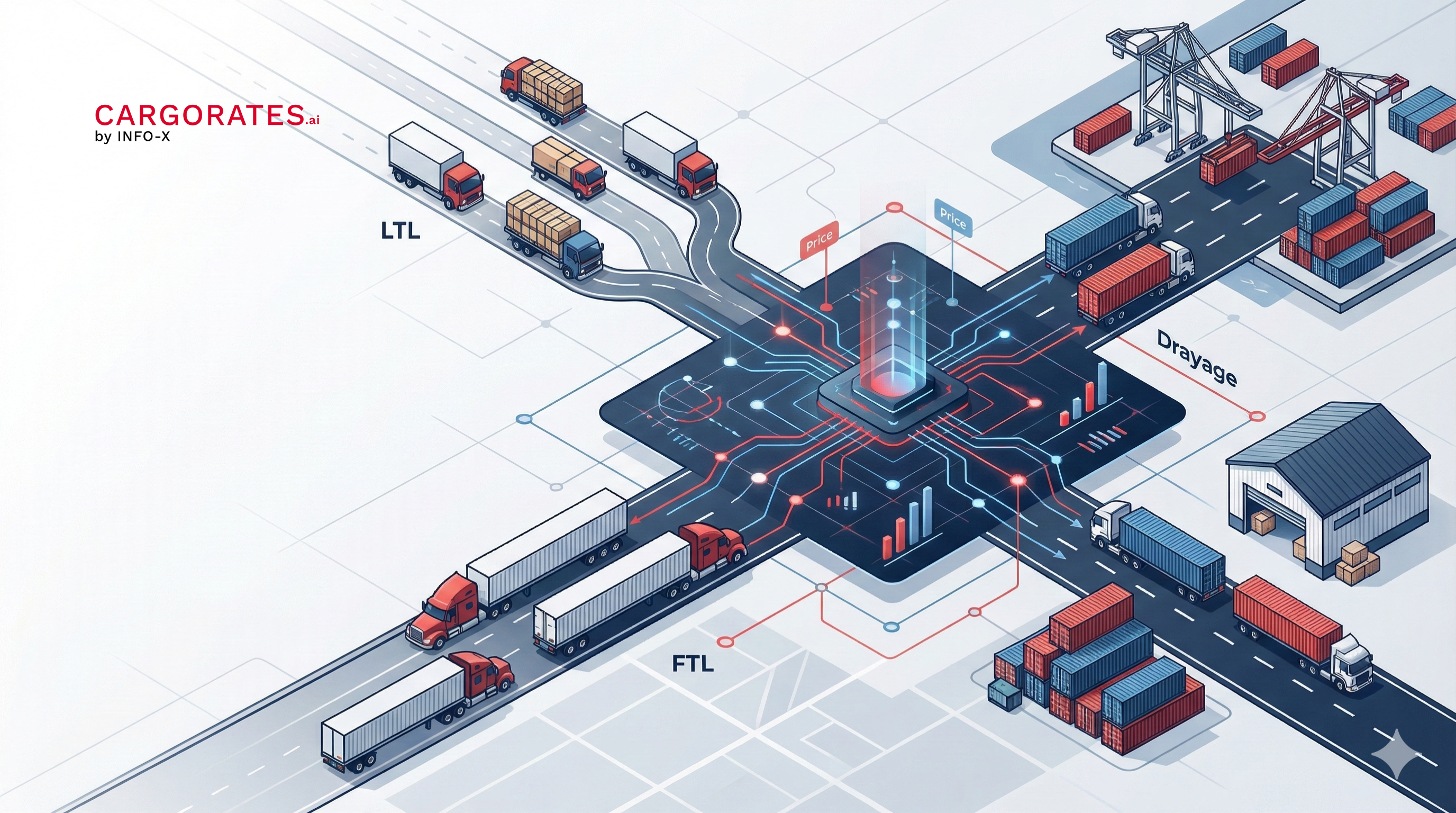
Getting instant freight rates online for LTL and full truckload shipments is no longer about convenience; it's about pricing accuracy, response speed, and margin control.
Yet many logistics teams still struggle to get rates that are fast and reliable.
This guide explains how instant LTL and FTL rates actually work, what most tools get wrong, and how modern freight rate management platforms like cargorates.ai enable logistics teams to generate decision-ready rates in seconds, not estimates that break later.
Instant freight rates are not static estimates. They are system-generated prices based on live data, carrier rules, and lane logic—designed to reflect real booking conditions.
For most logistics teams, the real challenge is not finding a fast quote, but ensuring that:
True instant pricing requires rate intelligence across the full freight lifecycle, not just the highway leg.
LTL pricing is structurally complex.
It depends on freight class, density, dimensions, accessorials, and carrier-specific tariffs.
Many tools rely on cached tariffs or averages, which leads to:
Modern freight rate management platforms generate instant LTL rates by:
This means the LTL rates you see are real-time carrier rates, not approximations, making them suitable for operational decisions, not just estimates.
Full truckload pricing is simpler structurally but more volatile.
FTL rates fluctuate based on:
Instant FTL pricing works when platforms:
This allows logistics teams to decide—at the moment of quoting—whether spot or contract is the better option for a given lane, instead of defaulting blindly.
One of the most common gaps in instant freight quoting is drayage.
For port-centric shipments, the linehaul rate is often not the cost driver—the drayage leg is.
As a result, many "instant" quotes exclude drayage entirely, forcing teams to manually price it later.
True instant drayage pricing requires:
In CargoRates, instant drayage rates are powered through Book Your Cargo drayage rate matrix, where real drayage execution data enables immediate, lane-specific drayage pricing—allowing port-to-door costs to be visible at the quoting stage, not after booking.
This closes one of the biggest gaps in freight rate management.
When LTL, FTL, and drayage are priced in isolation, quoting becomes fragmented and unreliable.
Modern freight rate management works when:
This unified approach eliminates re-quoting and allows logistics teams to respond to customers immediately with confidence.
Full truckload pricing is structurally simpler, but market-sensitive:
Instant FTL rates must pull from live spot rate intelligence, not static contract tables.
Cargorates.ai continuously aligns spot and contract FTL rates, allowing teams to choose the best option per lane at the moment of quoting — not after capacity disappears.
Instant rates are no longer a sales convenience. They are a control mechanism.
Teams using real-time freight rate management gain:
This shift is why the industry is moving toward instant pricing as a core capability, not an add-on—as discussed in Why 2025 Is the Year of Instant Freight Quotes and reinforced by the growing need to compare spot and contract pricing before committing.
Instant pricing only works when:
exist in one system.
Cargorates.ai acts as a single rate intelligence layer, eliminating the need to jump between emails, spreadsheets, and carrier portals.
The fastest way to lose margin is defaulting to contracts when spot is cheaper — or vice versa.
Modern teams compare:
before quoting.
This approach is explored further in Where Can I Compare Freight Spot Rates Before Booking?, and it's a core capability inside Cargorates.ai.
A rate without surcharges is not a rate — it's a risk.
Cargorates.ai automatically includes:
So the number your customer sees is aligned with the number your finance team expects.
True instant pricing improves over time.
Cargorates.ai analyzes:
This transforms freight rate management from a quoting function into a pricing intelligence system.
Instant freight rates are no longer a sales feature — they are pricing infrastructure.
Teams using CargoRates.ai benefit from:
This is why freight rate management is increasingly built around real-time rate engines, not manual workflows.
Even with modern tools, teams fail when they:
Cargorates.ai closes this gap by maintaining quote-to-execution continuity, ensuring pricing decisions are operationally valid.
Getting instant freight rates online for LTL and full truckload shipments isn't difficult anymore.
Getting accurate, defensible, and margin-safe rates is.
Cargorates exists precisely to solve this gap — combining speed, intelligence, and governance into a single freight rate management platform built for modern logistics teams.
When instant rates are powered by real data, embedded logic, and continuous learning, they stop being estimates — and start becoming strategic decisions.