Ocean Spot Rates: 2025 vs 2024 — A Clean, Sourced View for U.S.-Bound Trades
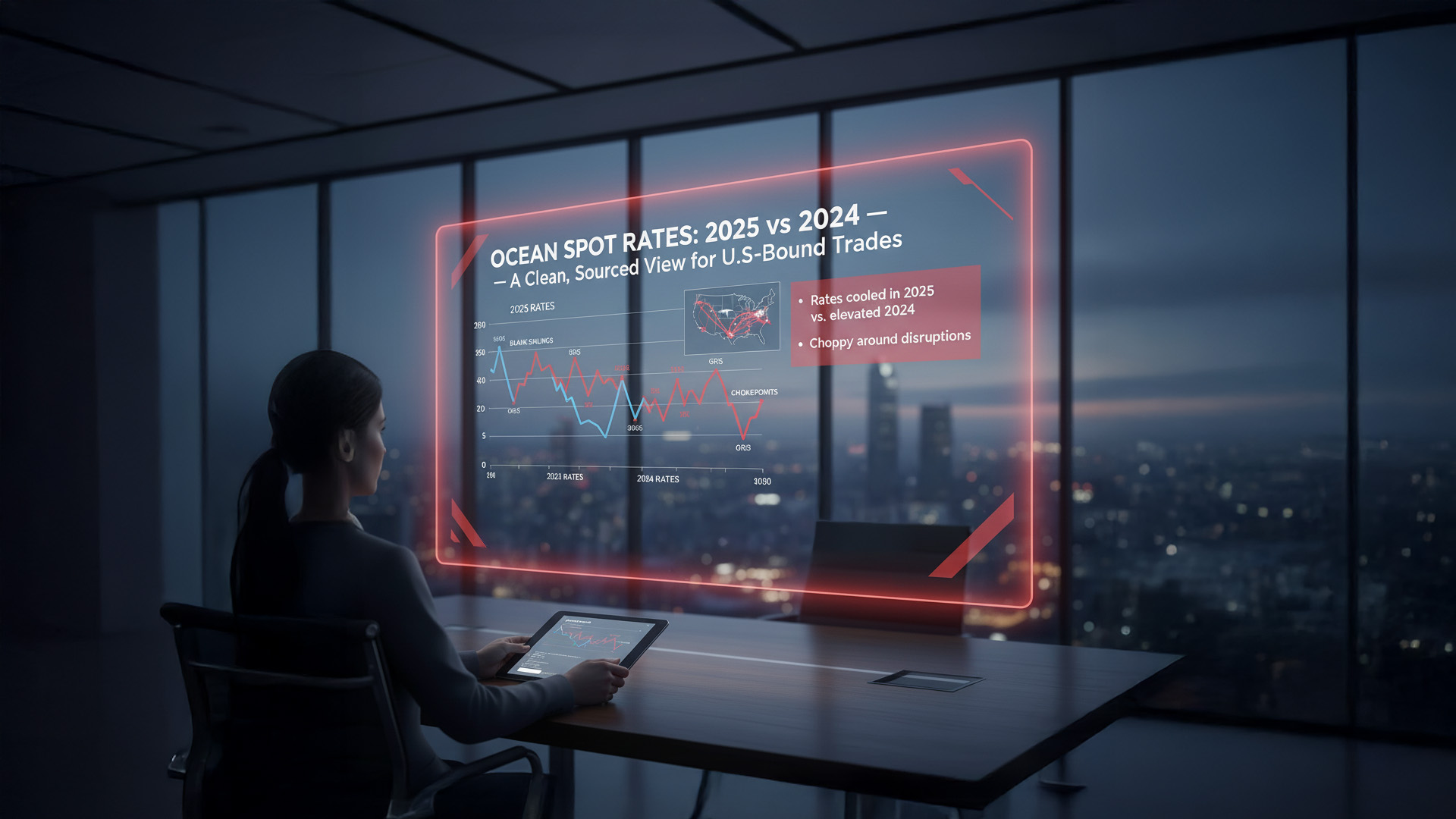
Ocean spot rates into the United States cooled through most of 2025 versus 2024 disruption highs, yet remained sensitive to GRIs, blank sailings, and chokepoints.
Ocean spot rates into the United States cooled through much of 2025 compared with the elevated levels seen in 2024’s disruption cycle, while remaining choppy around GRIs, blank sailings, and chokepoints. Below is a concise, fully sourced rundown—and how to operationalize it with Cargorates.ai.
What happened to global benchmarks?
- Global composite (WCI): Drewry’s World Container Index sat at $1,746 per 40ft on 23 Oct 2025, then rose to $1,822 on 30 Oct and $1,959 on 06 Nov after a 17-week slide earlier in the year—still materially below 2024’s disruption-driven highs. (Source: Security Cargo Network, Drewry)
Trend takeaway: 2025 tracked lower than 2024 peaks, with late-season GRIs nudging rates upward.
Transpacific to the U.S.: the numbers
- Far East → U.S. West Coast: Xeneta recorded $1,653–$2,044 per FEU across 15–23 Oct 2025.
- Far East → U.S. East Coast: The same window showed $2,588–$2,953 per FEU.
Context: Reuters noted Asia → U.S. spot rates fell sharply by mid-2025 as capacity growth outpaced demand and tariff uncertainty lingered, producing year-over-year declines on both coasts.
Why rates eased vs. 2024 — but stayed volatile
- Red Sea detours normalized (moderately): Rerouting that inflated 2024 costs began to ease, though security-related diversions and risk premiums persisted. (Sources: JPMorgan Chase, Financial Times)
- Panama Canal constraints lingered: Reduced transits and draft limits early-to-mid 2025 added friction for East/Gulf routings; conditions improved later but remained a planning variable. (Source: Supreme Freight)
- Supply outpaced demand: Additional capacity and softer volumes pushed spot levels down for most of the year, punctuated by tactical blankings and GRIs. (Source: Reuters)
Bottom line: Compared with 2024, U.S.-bound spot rates were generally lower for most of 2025, yet prone to short spikes around reliability shocks. (Source: Security Cargo Network)
What U.S. shippers and forwarders should do now
- Benchmark weekly: Use published indices like WCI and Xeneta to keep contract discussions grounded and pivot when spot undercuts. (Source: Security Cargo Network)
- Run a hybrid buy: Balance contract stability with opportunistic spot uptake when GRIs fade.
- Watch chokepoints: Track Red Sea security updates and Panama slot/draft notices for lane-specific adjustments. (Source: AP News)
- Quote fast: In volatile windows, the first accurate quote often wins—hours matter.
How Cargorates.ai operationalizes this (no fluff)
- Live spot in one place: Surface current spot offers from multiple carriers on Transpacific and other lanes without hopping sites—critical when indices swing.
- Side-by-side contract vs. spot: Upload contracts once, then compare instantly against live spot to decide lane-by-lane each week.
- One-click quoting & outcomes tracking: Generate customer-ready quotes (margins, surcharges) and monitor wins vs. lapses to refine pricing.
- Market-aware reporting: See GRIs, blankings, and chokepoint timelines in context to plan tenders and allocations with confidence.
The takeaway
- Fact: By late 2025, global and U.S.-bound spot rates sat below 2024 highs, with brief GRI-inspired rebounds. (Source: Security Cargo Network)
- Action: Pair rapid visibility with contract-vs-spot benchmarking to capture savings when they appear and defend budgets when volatility returns.
When macro shocks reappear, the teams that see spot swings first and quote accurately fastest keep customers and margins intact.
Final Thought
U.S.-focused logistics teams that combine sourced benchmarks with rapid quoting win the cargo when GRIs retreat and protect margins when they surge.
Cargorates.ai empowers forwarders, NVOCCs, and BCOs to move from static spreadsheets to live intelligence—covering Transpacific rates, reliability shocks, and customer-ready quotes in one ecosystem.
With unified insight across U.S.-bound lanes, you can react faster than the market and keep customers confident even as the rate cycle whipsaws.
FAQs
Drewry's World Container Index fell through most of 2025 after 2024's disruption highs, touching $1,746 per 40ft in late October before modest GRI-led rebounds.
Xeneta shows mid-October 2025 pricing of roughly $1,653–$2,044 per FEU to the U.S. West Coast and $2,588–$2,953 per FEU to the U.S. East Coast.
Normalizing Red Sea detours, lingering Panama Canal limitations, and an ongoing supply-demand imbalance pushed rates downward yet triggered short spikes around GRIs and blank sailings.
Maintain a hybrid strategy: keep contract coverage for stability, benchmark weekly, and switch to spot when GRIs fade to capture savings.
The platform aggregates live spot offers, compares them with your contracts, accelerates quoting, and surfaces market intelligence so you can plan tenders and allocations with confidence.
Source library
Book a Demo →
