Revitalizing the Freight Forwarding Industry: Addressing the Labor Crisis: Why Leaders Hesitate to Act

IBy L. Sanford, Marketing Partner at Info-x - April 26, 2024
1. Leadership Hesitancy Amidst the Labor Shortage
Let's be blunt: as logistics wages surge and talent becomes scarcer, a significant portion of SME forwarding firms exhibit reluctance to pursue necessary business advancements crucial for scalability, economic growth, and long-term resilience. Despite the availability of cost-effective AI & ML-infused technological solutions, complemented by more efficient back-office process management services, why do proven offerings like Rate Management and "Human-in-the-Loop" technology partnerships remain underutilized? What prevents these investments from being recognized as prudent choices for enhancing efficiency and gaining competitive edges through modest monthly investments? To unravel this conundrum, let's examine the primary obstacles hindering freight forwarders' pursuit of digital transformation objectives.
2. Overcoming Overwhelming Advice and Information Overload
Navigating the path forward is daunting. Whether due to internal expertise limitations or the deluge of external advice, freight forwarders often find themselves overwhelmed by a massive amount of information on options. The internet has transformed into a fire hose of data, challenging us to extract actionable insights amidst the outpouring. Exploring technology vendors' websites can feel like wandering in a jungle of pop-ups. Professional consultants bombard firms with an abundance of solutions. Website and consultant promises often exceed a forwarder’ needs and financial capacity.
While business leaders keenly feel their pain points, they often lack the clarity required for decisive action. A fresh perspective is sorely needed to distil best practices and pinpoint the precise cloud logistics solutions, software applications, and back-office services necessary for optimal forwarding process enhancements.
3. Logistics Sector Research Insights
To initiate a search for underlying facts and answers, I delved into familiar territory: a wealth of historical data from Info-X's global clientele. The aim was to uncover reasons behind their adoption of Info-X software, technology, and back-office solutions. Two prevailing factors emerged, resonating across the broader logistics industry:
Their clients often faced either high internal operating costs, particularly in wages, or a shortage of tech-proficient staff essential for efficient digital transformation.
Their clients, primarily, Forwarders, NVOCCs, Carriers, and BCO’s, sought heightened efficiency, improved margins, sustainability, and enhanced competitiveness. Simply put, they aspired for economic advantages and operational excellence to facilitate scalable growth at reduced expenses.
Subsequently, I conducted an external exploration by searching for "logistics labour and skill shortage" on Google, yielding a myriad of hyperlinks; no less than 100. Sifting through these sources, distilling, and synthesizing abundant information led to the following discoveries:
Each source corroborated the existence of high wages, talent deficits and lack of executive action, as a crisis within the industry, elaborated on the underlying causes and offered the author's perspective on viable solutions.
Generally, these articles advocated for a multifaceted approach, emphasizing the importance of improved leadership, wage adjustments, reskilling initiatives, and the utilization of advanced technology tools to attract and retain skilled talent. Five prominent sources revealed:
A. Statistics
63% of companies are experiencing a supply chain talent gap. (3)
UK firms with talent shortage say less than 2 of 5 employees had skills for digital growth. (3)
The same UK firm survey reported technology initiatives failed at 4 of every 5 businesses. (3)
37% of UK logistics firms have outdated systems hindering adoption of digital processes. (3)
Almost a third (32%) of UK logistics employees work unpaid overtime. (4)
The logistics sector expects a 400,000-person labour shortage by 2026. (4)
15% of employees in the sector have experienced burnout. (4)
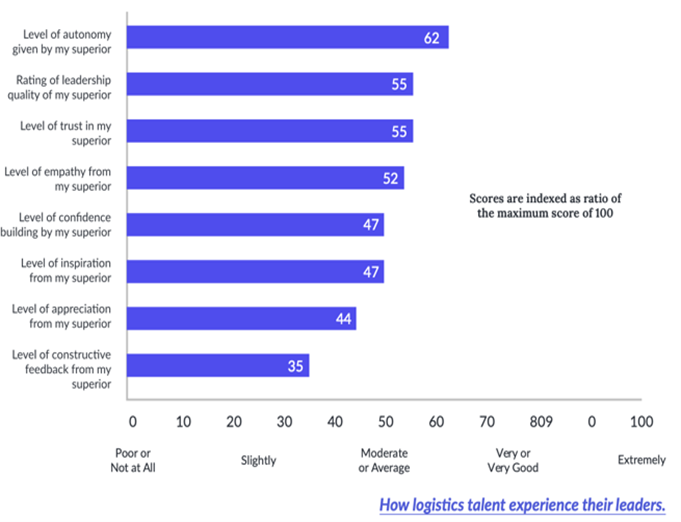
*Source EN_Logistics_Upskilling Checklist
B. Opinions
Ryan Craig’s article reminds us that Deloitte, back in 2018, said in the supply chain paradox, companies consistently prioritize investments in their “digital supply chains” while failing to view supply chains as a driver of innovation. He goes on to say, “It seems likely that companies aren’t taking full advantage of their digital investments because they don’t have the talent to do so.” (2)
Steve Parker, BIFA, in short, says digital development investment can be seen as a high cost in a sector with typically very low profit margins, logistics needs talent with in-depth technical knowledge, logistics careers lack appeal, many firms invested heavily in out-dated legacy systems difficult and expensive to replace. (3)
4. Key Findings and Recommendations
Logistics senior management must embrace smart, cost-effective technology solutions and delegate low-level tasks to outsourced back-office support services. This strategic shift gives existing staff more time to focus on sales and service, enables enhanced operational efficiency, facilitates talent retention and attraction, improves profit margins, fosters innovation, and bolsters competitiveness.
While efficiency improvements may require investment, they need not be prohibitively expensive. Embracing new technology and recruiting fresh talent often go hand in hand. Efficiency and effectiveness can be realized for as little as $500 to $2,000 per month.
Despite the clear benefits, many freight forwarders have yet to fully leverage affordable technology and back-office support services as the most expedient route to growth. Furthermore, underutilizing technology hampers efforts to position shipping roles as attractive career paths, perpetuating the misconception that it’s all manual and tedious work.
The adoption of digital logistics, powered by autonomous AI-driven processes, enables companies to shed the inefficiencies, inaccuracies, and delays associated with manual data entry, traditional document management, and excessive communication with carriers.
Beyond the findings presented here, industry publications such as Lapaya, Logistics UK, Paragon, Prologis UK, Harvard Business Review, Raconteur, and SCMtalent, also highlight similar challenges and negative consequences stemming from logistics skill shortages and escalating administrative costs.
Noted References:
S Scope Recruiting: https://www.scoperecruiting.com/blog/why-investment-in-technology-and-people-must-go-hand-in-hand-
Ryan Craig, Forbes Magazine, 08February 2024: https://www.forbes.com/sites/ryancraig/2024/02/08/the-supply-chain-of-supply-chain-talent-is-broken/
Motor Transport UK, April 2024: https://motortransport.co.uk/logistics-sector-suffering-from-digital-skills-gap/18514.article?adredir=1
Manufacturing & Logistics, 18/04/2024: https://www.logisticsit.com/articles/2023/08/16/burnt-out-britain-a-third-of-employees-in-transport-and-logistics-working-unpaid-overtime
Other References:
Lapaya; EN_Logistics_Upskilling_Checklist https://www.lepaya.com/
Harvard Business Review: https://hbr.org/2023/09/how-to-address-the-supply-chain-staffing-crisis
Logistics UK: Staff shortages halting the wheels of logistics.
Prologis: Driving Employment Growth Within The UK's Logistics Sector