Blog

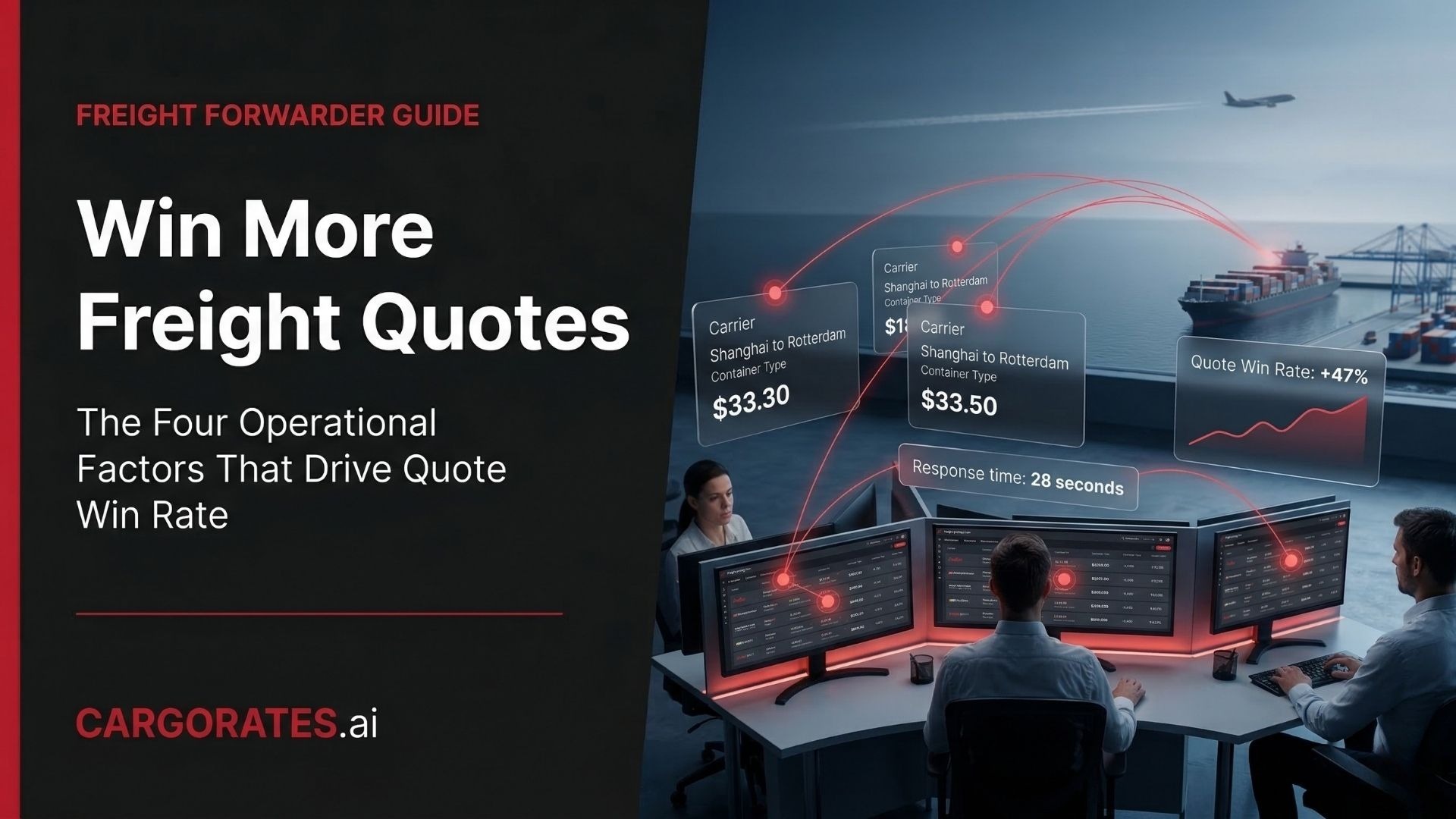
Most freight forwarders think about quote win rate as a commercial problem. The solution they reach for is hiring better salespeople, reducing margins to compete on price, or chasing shipper relationships harder. These responses are understandable but they address the wrong part of the problem.
Quote win rate is primarily an operational problem. The forwarder that wins the most quotes is rarely the one with the lowest price. It is the one that responds first with a complete, accurate quote that gives the shipper everything they need to make a decision without waiting for a follow-up. Speed and accuracy consistently outperform price as win rate drivers because shippers are not only evaluating cost. They are evaluating reliability, professionalism, and the confidence that the forwarder will execute without surprises.
The four factors that determine whether a freight forwarder wins or loses a quote are all operational. This guide covers what each one is, how manual quoting processes undermine it, and how a purpose-built freight rate management platform for forwarders and NVOCCs addresses each one systematically.
When a shipper sends a freight rate request, they are almost always contacting multiple providers at the same time. This is standard procurement practice and experienced shippers have it down to a process: the enquiry goes to three or four forwarders, the first credible response is the one that gets the most attention, and the booking decision is made faster than most forwarders realise.
This dynamic means the race is decided in the first hour of a quote request, often in the first few minutes. A forwarder with better carrier relationships but a slower quoting process will consistently lose to a forwarder with average carrier relationships but a faster, more automated quoting operation. The relationship advantage is real but it only applies if the forwarder reaches the shipper first.
Pricing also matters less than most forwarders assume. Shippers are not running blind auctions where every provider is measured purely on price. They are evaluating total confidence in the provider. A quote that arrives in 30 seconds, covers all surcharges, presents two or three carrier options with transit times, and is delivered through a professional interface signals operational competence. A quote that arrives the next day after a series of clarifying emails, contains only a base rate, and lists one carrier option signals the opposite.
Response speed is the single most important factor in freight quote win rate. In a market where shippers contact multiple providers simultaneously, the forwarder that responds first with a complete quote captures the shipper's attention before any competitor has responded. This is not a marginal advantage. First-response advantage in freight quoting is structural: the shipper has already mentally benchmarked the first response and every subsequent quote is evaluated against it.
In a manual quoting operation, producing a complete FCL quote involves locating the applicable carrier rate file, verifying its validity date, calculating surcharges from separate tables, applying margin, and formatting the output. This chain of steps takes two to eight hours for a standard request. With an automated platform, the same quote is produced in under 30 seconds.
The difference in response time is not a competitive edge. It is the difference between a quoting operation that wins systematically and one that is always competing from behind.
A fast quote that does not match the eventual invoice is not a winning quote. It is a liability. When a shipper books based on a quoted price and then receives an invoice that includes additional surcharges that were not in the original quote, they lose confidence in the forwarder regardless of how competitive the original price appeared. Invoice disputes are among the most common reasons shippers switch freight providers.
The root cause of surcharge omission is almost always the same: surcharges are calculated manually at the quoting stage rather than being attached to the rate at the point of upload. BAF tables change monthly. PSS is seasonal. GRI can arrive with two weeks notice. When a pricing team member retrieves a carrier rate and manually adds surcharges from memory or from a separate table that may not be current, the probability of omission is high.
Accurate quotes require surcharge management to be a system function, not a human one. When surcharge profiles are associated with each carrier and lane at the rate entry stage, every quote the platform generates is automatically surcharge-complete based on the current applicable charges for that carrier, lane, container type, and date. The gap between quoted price and invoiced price closes to zero.
Shippers expect freight forwarders to present the best available option across the market, not just a rate from whichever carrier the pricing team happens to check first. When a forwarder presents a single carrier option, they are delivering less value than the shipper expects and less than a competitor with a broader carrier comparison capability is delivering.
In a manual operation, presenting three carrier options on the same trade lane means repeating the full rate lookup, validity check, surcharge calculation, and margin application process three times. Under time pressure, this is rarely done. The practical result is that most manual quoting operations present one or two carrier options at most, and often only one.
With a centralised rate management platform, all available carrier options for a trade lane are surfaced simultaneously in a single view. The forwarder can present the shipper with a full carrier comparison including price, transit time, routing, and surcharge-inclusive totals without any additional work. This directly increases the perceived value of the quote and the confidence the shipper places in the forwarder as a market expert rather than a single-carrier reseller.
Margin consistency is less visible to shippers than the other three factors but it has a direct impact on the long-term profitability of winning more quotes. When a freight forwarder grows its quote volume through faster, more accurate quoting, the benefit is only commercially meaningful if the margins on those quotes are consistently applied.
In manual quoting operations, margin application varies by team member, by the familiarity of the lane, and by how busy the pricing desk is on a given day. Under time pressure, margins are often compressed to close the deal quickly. On low-volume or unfamiliar lanes, markup is applied inconsistently because there are no fixed rules. Over time this creates margin leakage that erodes the commercial return from higher quote volumes.
Pre-configured margin rules applied at the platform level close this leakage. When markup is set by lane, carrier, customer segment, or container type and applied automatically to every quote the platform generates, the forwarder wins more quotes at consistent margins. Volume growth translates directly into revenue growth rather than being partially absorbed by inconsistent pricing decisions.
Every one of the four win rate factors is directly degraded by a manual quoting process. Understanding where each failure occurs makes clear why the solution is systemic rather than incremental.
| Win Rate Factor | How Manual Quoting Undermines It | Operational Impact |
|---|---|---|
| Response speed | Rate lookup, validity check, surcharge calculation, and margin application all performed manually and sequentially | 2 to 8 hours per quote; forwarder consistently loses first-response advantage |
| Quote accuracy | Surcharges added from memory or separate tables at quoting time; BAF and PSS tables frequently outdated | Quoted price diverges from invoice; shipper trust erodes; repeat business at risk |
| Carrier optionality | Multi-carrier comparison requires repeating full manual process for each carrier; not done under time pressure | Shippers receive one or two options instead of the full market view; forwarder appears to lack market coverage |
| Margin consistency | Markup applied differently by different team members; compressed under volume pressure; inconsistent on unfamiliar lanes | Margin leakage across quote book; volume growth does not translate to proportional revenue growth |
The critical point here is that these failures compound. A forwarder that is slow to respond has already lost first-response advantage. If the quote that finally arrives is missing surcharges and shows only one carrier option, the shipper has effectively received three reasons not to book. No amount of competitive margin adjustment overcomes all three.
Cargorates.ai is built specifically to address the operational failures that depress freight forwarder quote win rate. Every capability in the platform maps directly to one or more of the four factors. This is not a general-purpose logistics tool. It is a rate management platform designed around the quoting workflow that determines whether a forwarder wins or loses business.
The rate lookup step disappears when all carrier contracts are centralised. Cargorates.ai allows forwarders to upload and manage contracts from every carrier they work with, structured by trade lane, container type, validity period, and surcharge profile. When a request arrives for an Asia to Europe FCL shipment, the platform already has every applicable contract loaded and instantly queryable. No file search, no shared folder navigation, no email hunt.
Alongside contract rates, the platform provides access to real-time spot rates. Forwarders can compare live spot market pricing against contracted rates simultaneously at the moment of quoting, without checking a separate portal or calling a carrier pricing desk. As explored in detail in our guide on how and where to compare freight spot rates before booking, having this comparison available in a single view removes one of the most time-consuming manual steps in the quoting process.
The result is a complete quote delivered in under 30 seconds from the moment the request arrives. The same response that previously took two to eight hours now goes out before most competitors have even opened the email.
Cargorates.ai resolves surcharge omission by moving surcharge management to the rate entry stage rather than the quoting stage. When a carrier contract or spot rate is uploaded, the applicable surcharge profile is associated with it at that point. BAF tables are linked to carrier and trade lane. PSS windows are set by season. THC is configured by origin and destination port. When a quote is then generated, all applicable surcharges are applied automatically based on the carrier, lane, container type, and current date. The pricing team does not calculate surcharges. The platform applies them. Every time. Without exception.
This closes the gap between quoted price and invoiced price that is the most common cause of shipper trust erosion. The full relationship between surcharge automation and invoice dispute reduction is covered in our piece on how ocean freight rate management works from sourcing through to rate governance, which details why surcharge management at the rate entry stage is the standard that professional quoting operations should be built around.
Cargorates.ai surfaces all available carrier options for a trade lane simultaneously in a single view. Forwarders see pricing from every relevant carrier side by side, with transit times, routing details, and surcharge-inclusive totals, without any sequential manual checking. The forwarder can present the shipper with a genuine market comparison in a single response rather than a single-carrier rate that the shipper cannot contextualise.
Live vessel schedules are integrated directly into this view. When a quote is generated, sailing options including transit time, transshipment details, and estimated departure dates are available alongside the rate. The forwarder delivers a routing-complete, carrier-complete quote in one step, which is the standard a shipper with multiple providers to compare will reward.
Margin rules are set at the platform level by the forwarder's pricing leadership and applied automatically to every quote the platform generates. Rules can be configured by lane, carrier, customer segment, or container type. Once set, they apply regardless of which team member generates the quote, which lane it covers, or how much volume the desk is handling.
This is the capability that converts higher quote volume into higher revenue rather than just higher operational activity. As explained in our article on why instant freight quoting has become operationally essential across logistics, the forwarders that scale profitably are those that have removed the manual margin decision from individual team members and governed it at the system level.
The four win rate factors described above address what happens once a quote request is being processed. But quote win rate is also affected by what happens before processing begins: the intake step.
In most forwarding operations, a quote request arrives by email or phone. A team member reads it, manually transcribes the shipment details into the quoting system, and then the quoting process begins. This intake step typically adds 15 to 45 minutes before any rate lookup even starts. For a team handling high quote volumes, this intake bottleneck compounds the manual quoting delays and pushes average response times well beyond the competitive window.
The Cargorates.ai Digital Customer Portal eliminates this step entirely. Shippers submit quote requests through a branded, self-service interface under the forwarder's name. The request enters the platform already structured and ready for processing. There is no manual transcription, no email chain to manage, and no delay between the shipper pressing submit and the quoting engine beginning its work.
The same portal allows shippers to track active shipments in real time, download shipping documents, view their rate history, and manage bookings without calling the forwarder's operations team. For the shipper, this is a materially better experience than managing freight through email threads. For the forwarder, it means the customer relationship is anchored in a professional digital interface rather than a fragmented inbox, and the operational cost per quote is lower because intake is automated.
The impact on win rate is direct. A shipper who submits a request through the portal and receives a complete, surcharge-inclusive, multi-carrier quote in under 30 seconds has experienced something that a competitor relying on email quoting cannot match. The experience quality becomes part of the competitive advantage, not just the price.
| Quoting Step | Manual Forwarding Operation | Forwarder Using Cargorates.ai |
|---|---|---|
| Request intake | Received by email, manually transcribed into quoting system | Submitted via Digital Customer Portal, structured and ready to process instantly |
| Rate lookup | Team member searches email, shared drives, and spreadsheets for applicable carrier rate | All carrier contracts centralised and instantly queryable by lane, carrier, and container type |
| Validity check | Rate validity checked manually; outdated files often retained without a reliable deletion process | Contract version control and expiry tracking handled automatically from point of upload |
| Surcharge calculation | BAF, PSS, THC, CAF manually added from separate carrier-provided surcharge tables | All applicable surcharges applied automatically by rule-based profile at the point of quote generation |
| Carrier comparison | Multi-carrier comparison requires full manual process repeated for each carrier; rarely completed under time pressure | All contracted carriers compared simultaneously in a single view with transit times and routing included |
| Margin application | Markup calculated and applied manually; varies by team member and workload | Pre-configured margin rules applied automatically per lane, carrier, or customer segment |
| Routing information | Vessel schedules checked separately on carrier websites or by calling schedule desks | Live vessel schedules integrated into the quote; transit time and sailing options shown alongside rate |
| Quote delivery | Formatted manually into an email template and sent | Delivered via Digital Customer Portal in under 30 seconds from request receipt |
| Total response time | 2 to 8 hours | Under 30 seconds |
The commercial impact of improving quote win rate is not incremental. When a forwarder moves from winning 30 percent of quotes to winning 50 percent of quotes, without any additional lead generation or sales activity, their bookings increase by approximately 67 percent from the same enquiry volume. This is the leverage that operational improvement creates on commercial outcomes: the same number of quote requests, handled by the same team size, produces materially more business.
The compounding effect comes from three directions simultaneously. More quotes won from the same enquiry volume increases revenue directly. Faster response time means the team can handle more quote requests per day, increasing the total volume from which wins are drawn. And consistent margin application means each of those wins contributes its intended margin to the business rather than being partially eroded by inconsistent pricing decisions.
Cargorates.ai customers report 12 to 15 times faster RFQ responses and 45 to 50 percent improvements in quote win rate. The platform processes 1,000 daily rate searches, a volume that is operationally impossible for teams relying on manual quoting processes regardless of headcount. As described in our overview of how predictive rate pricing empowers logistics professionals, the shift from reactive to proactive, data-driven quoting is what separates freight forwarders that scale from those that stagnate.
Winning more quotes generates data. Every quote that goes out, every booking that comes back, and every lane that is consistently competitive or consistently lost tells the forwarder something about their market position. Most forwarders do not capture this intelligence because their quoting process does not generate structured data. Quotes go out by email and win or loss outcomes are tracked, if at all, in disconnected spreadsheets.
Cargorates.ai Smart Reports converts the platform's daily quoting activity into lane-wise analytics and team-ready dashboards. Forwarders can see which carriers are consistently competitive on which lanes, where contracted rates are being underutilised, and where their pricing is winning or losing against market spot conditions. This information directly improves the quality of carrier negotiations at renewal time. A forwarder who can demonstrate utilisation patterns and rate competitiveness by lane has a materially stronger position in carrier contract discussions than one who brings only volume commitments and hope.
The analytics layer also helps pricing teams identify where margin rules may need adjustment. A lane that consistently wins at the current margin level is a candidate for a margin increase. A lane where quotes are going out but win rates are below average may indicate a pricing issue rather than a service issue. Systematic rate intelligence allows forwarders to make these decisions based on data rather than intuition.
The four win rate factors operate together, not independently. A forwarder that solves one without solving the others does not capture the full advantage. Faster quoting without accurate surcharges wins the first response race but loses on trust when the invoice arrives. Accurate surcharges without carrier optionality produces a complete single-carrier quote that a competitor with a broader comparison will still beat. Carrier optionality without consistent margins means some of those wins are priced below where they should be.
The compounding advantage comes when all four factors are addressed simultaneously on a single platform. A freight forwarder operating on Cargorates.ai responds in under 30 seconds with a surcharge-complete, multi-carrier comparison including vessel schedules, delivered through a professional digital portal, at a consistently governed margin. This is not a marginal improvement over a manual operation. It is a structurally different quoting capability that changes how shippers evaluate the forwarder in every competitive situation they are in.
For forwarders evaluating whether to move from manual quoting to a rate management platform, the relevant comparison is not the cost of the platform against the cost of the current process. It is the revenue impact of winning 45 to 50 percent more of the quotes the team is already generating, applied across every trade lane, every carrier, and every customer in the book.
See how Cargorates.ai helps freight forwarders respond faster, quote more accurately, and present multi-carrier options in under 30 seconds across every trade lane.
Schedule a Demo