Blog

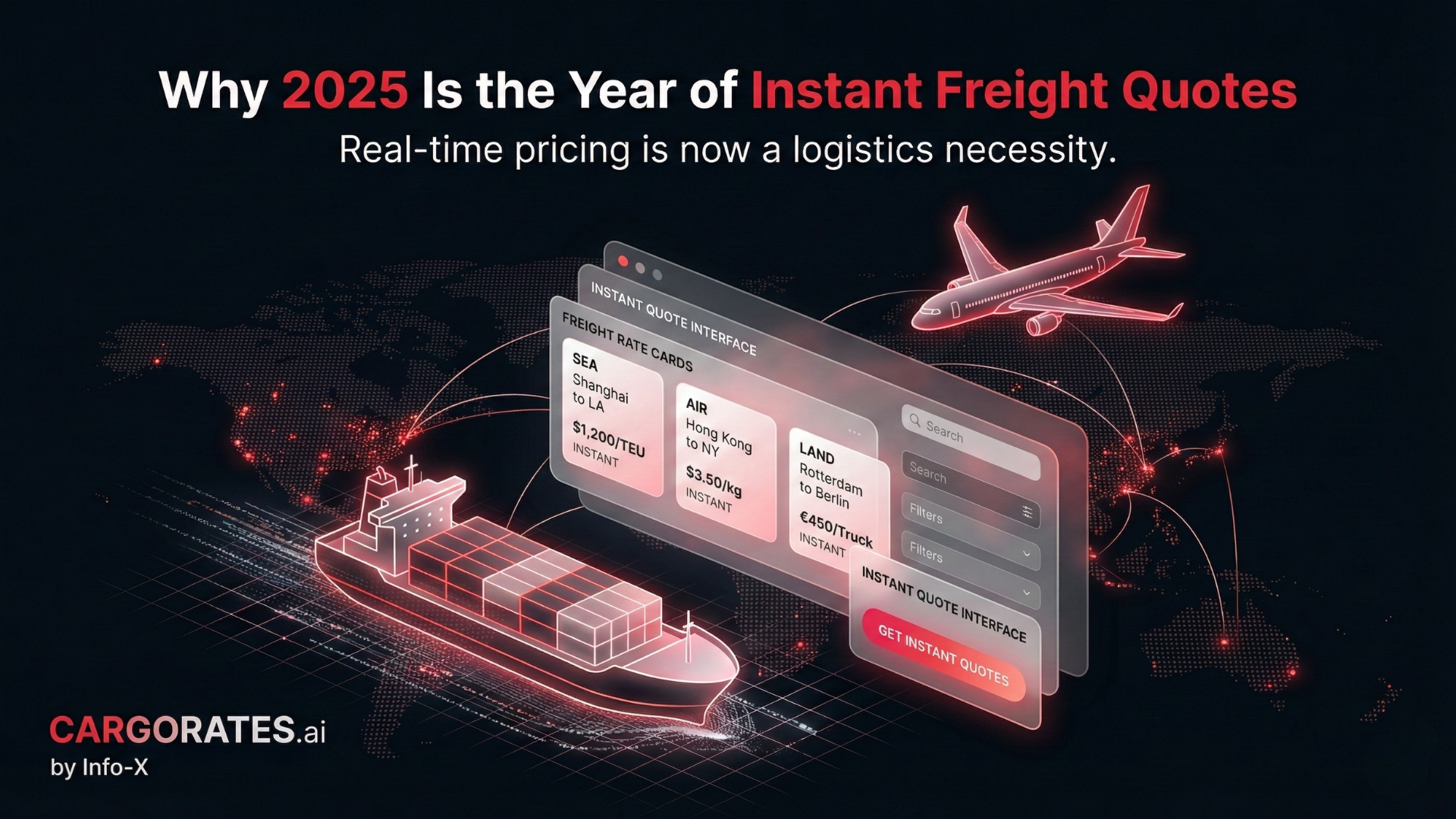
Discover why instant freight quotes are essential in 2025 for BCOs, NVOCCs, and forwarders navigating volatile markets and complex surcharge structures.
"Instant freight quotes are essential in 2025 due to daily rate fluctuations, complex surcharge structures, and increased expectations for immediate, transparent pricing. Automated quoting systems combine real-time spot rates, contract comparisons, surcharges, vessel schedules, and multimodal tracking to deliver accurate, immediate online freight rates. These capabilities outperform manual rate sheets and spreadsheets, making instant quoting a critical operational advantage for logistics teams."
The freight industry enters 2025 at a moment when volatility, fragmented pricing structures, and rising expectations for immediate clarity define daily operations. Shippers, freight forwarders, NVOCCs, BCOs, and logistics teams must navigate fluctuating ocean freight rates, dynamic air freight markets, unpredictable surcharges, and operational inefficiencies caused by outdated manual quoting practices. In this environment, instant freight quotes are not an optional digital upgrade—they are a structural requirement for accurate, timely, and transparent decision-making.
Instant pricing aligns with how modern supply chains operate: fast, data-driven, and digitally interconnected. With technologies now capable of consolidating surcharges, pulling real-time AI-powered spot rates, comparing contract rates, retrieving vessel schedules, and enabling multimodal track & trace, quoting has evolved far beyond rate sheets and spreadsheets. This blog explains why 2025 marks the decisive shift toward instant quote infrastructure across global logistics networks.
Global freight markets have become increasingly dynamic. Ocean freight rates fluctuate frequently due to capacity shifts, carrier strategies, geopolitical factors, and port disruptions. Air freight markets remain sensitive to fuel costs, available aircraft capacity, charter demand, and lane-specific conditions.
With traditional rate sheets or Excel files updated weekly—or sometimes monthly—pricing teams become disconnected from real market conditions. The lack of real-time access means that quotes delivered manually are often outdated before they reach the customer.
Instant freight quotes resolve this gap by providing up-to-the-minute online freight rates across ocean and air lanes. This capability ensures that quoting aligns with the actual pricing environment of 2025, supporting operational accuracy and strategic decision-making.
Across industries, customers have grown accustomed to frictionless digital experiences. The logistics sector is no exception. Shippers now expect transparency, speed, and clarity when requesting freight pricing. Long wait times for rate responses feel incompatible with modern supply chain needs.
A shipper comparing ocean freight rates for Asia–Europe lanes, for example, may require immediate visibility of charges, transit times, and vessel options. If two forwarders respond several hours apart, the one delivering instant clarity wins.
Instant freight quotes align with this demand by providing transparent, surcharge-inclusive pricing that helps customers make informed and timely choices.
Traditional quoting workflows depend heavily on PDFs, email requests, spreadsheets, and repeated manual inputs. These methods increase:
Even a small oversight—like referencing an outdated surcharge—can create unexpected financial variances. These risks accumulate when quoting volume increases, especially during peak seasons.
By contrast, freight quote automation consolidates all rate components including surcharges, accessorials, and carrier conditions. Automated quoting ensures accuracy and minimizes the possibility of human errors that typically arise in manual systems.
Modern freight procurement strategies rely on evaluating both contractual and real-time spot rates. Without access to both in the same workflow, logistics teams cannot optimize pricing decisions effectively.
For example, a forwarder may need to decide between a stable contract rate and a volatile but potentially cheaper spot rate. Real-time comparison becomes essential to ensure margin protection and operational flexibility.
Instant freight quote systems support these decisions by integrating AI-enabled spot feeds with contract rate libraries, enabling teams to choose the best option for each shipment scenario.
BAF, CAF, PSS, PCS, GRI, ISPS, THC, and seasonal surcharges change frequently and vary between carriers. Manually updating and aligning these details across teams is time-consuming and error-prone.
A miscalculated or outdated surcharge not only hurts profitability but can also create inconsistencies across quotes sent to different clients.
Surcharge-inclusive pricing eliminates this risk by consolidating surcharges automatically at the system level. Every instant freight quote becomes standardized, precise, and aligned with the most current carrier updates.
Today, freight quoting isn’t only about the cost. Customers expect visibility into:
A quote that includes visibility elements helps customers evaluate not only price but also service reliability and transit performance. This supports better comparisons between alternate routes, modes, or carriers.
Advanced quoting systems that integrate vessel schedules and track & trace capabilities enable more holistic decision-making at the quoting stage.
Professional logistics organizations increasingly provide digital customer login portals, allowing clients to:
A seamless digital experience elevates trust and creates consistency across customer interactions. Instant quoting integrated into a customer portal strengthens the overall service structure and reduces dependency on email exchanges.
Freight forwarders and NVOCCs often receive dozens—or even hundreds—of rate requests per day across multiple trade lanes. Scaling manual quoting teams proportionally is neither efficient nor sustainable.
Automated pricing engines and structured rate management workflows enable organizations to handle peak season volumes without delays, backlog, or reduced accuracy.
Fragmented rate sources create inconsistencies across quotes, even within the same organization. Two pricing analysts referencing different spreadsheet versions may produce conflicting quotes for the same lane.
Centralized rate engines unify:
This ensures that every quote generated—whether from the pricing desk or a customer portal—is aligned, accurate, and consistent.
The shift toward intelligent quoting reflects the evolution of modern logistics. Intelligent quoting combines real-time pricing, automation, surcharge accuracy, track & trace visibility, contract comparisons, and features like My Favorite Rates that help teams retrieve frequently quoted lanes instantly.
The transition from manual quoting to intelligent, automated, real-time quoting marks 2025 as the defining year in which digital pricing becomes a foundational capability rather than an optional upgrade.
The evolution of instant freight quotes reflects a broader transformation across global logistics. In 2025, volatility, complex surcharge structures, and customer demand for immediate clarity make real-time quoting essential for operational efficiency. Automated, accurate, and transparent quoting supports better decision-making and aligns with the digital expectations shaping the industry.
Organizations positioned for this shift will be better equipped to navigate the complexities of global logistics and deliver consistent value in a rapidly accelerating environment.
2025 marks the shift from manual to intelligent quoting due to pricing volatility, surcharge complexity, and demand for real-time visibility. Instant freight quotes help teams respond faster with accurate, automated, and transparent pricing.