Blog

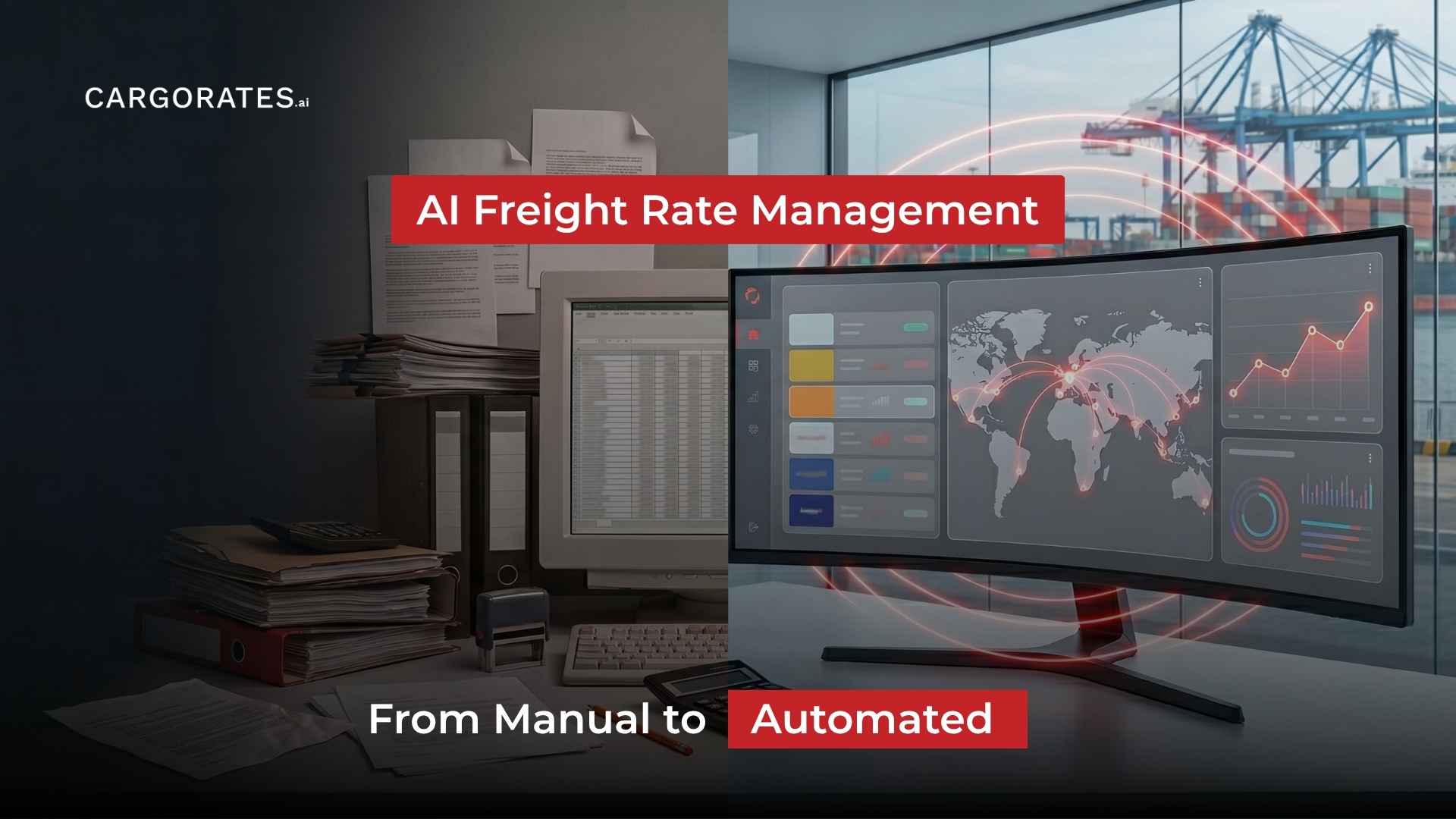
AI freight rate management is the use of artificial intelligence and automation to centralise carrier contracts, apply surcharges automatically through rule-based profiles, compare multiple carriers in real time, and generate instant surcharge-inclusive quotes without manual intervention at each step. For freight forwarders, this means going from two-to-eight-hour manual quote cycles to responses in under 30 seconds. For BCOs, it means replacing spreadsheet-driven contract management with a platform that benchmarks contracted rates against live spot rates, tracks allocation utilisation by trade lane, and builds the analytics needed to negotiate better in the next tender cycle. Cargorates.ai delivers this automation for NVOCCs, freight forwarders, and Beneficial Cargo Owners across ocean, air, and domestic freight.
Freight rate management has always been operationally intensive. Carrier contracts arrive in different formats from different carriers on different schedules. Surcharges change monthly, seasonally, and with market events. Spot rates fluctuate independently of contracted rates. Shippers expect responses faster than manual teams can generate them. And every quote that goes out with a missing surcharge or an expired rate creates a downstream problem at invoice time.
The freight logistics industry has historically managed all of this through a combination of spreadsheets, shared drive folders, email inboxes, and the accumulated institutional knowledge of experienced pricing staff. That approach works up to a point. But it has a ceiling on speed, a ceiling on accuracy, and a ceiling on the volume of quotes a team can handle before quality begins to degrade.
AI-powered rate management removes those ceilings. Not by replacing the people who run freight operations, but by replacing the manual steps in their workflow that consume time without adding judgment. This guide explains what that transition looks like in practice, what it delivers for freight forwarders and BCOs at each stage, and what the platform infrastructure behind it actually does.
Before examining what AI automation changes, it is worth being precise about what it is replacing. Manual freight rate management is not a single task. It is a chain of interdependent steps, each of which introduces its own delay and its own failure risk.
A pricing team member handling a quote request in a manual operation begins by locating the applicable carrier rate. This typically means searching an email inbox for the most recent rate sheet from a specific carrier, checking a shared drive folder, or opening a spreadsheet that may or may not reflect the current state of the contract. The rate then needs to be checked for validity: rate sheets expire, and without a version control system, teams frequently quote from outdated files without realising it.
Once the rate is located and verified, surcharges need to be calculated separately. BAF changes monthly. PSS is applied in seasonal windows. THC varies by port. CAF applies to certain currency corridors. Each of these is typically tracked in a separate document, and the team member needs to identify which surcharges apply to the specific carrier, trade lane, container type, and shipping date in question. This step alone is where most invoice discrepancies originate: surcharges are missed, outdated, or inconsistently applied depending on who handles the quote.
After the surcharge calculation comes margin application, formatting, and email delivery. If the shipper wants a multi-carrier comparison, the entire process repeats for each additional carrier. Under time pressure, it almost never does.
The cumulative result is a quote process that takes two to eight hours per request, produces inconsistent surcharge coverage across the team, offers limited carrier comparison, and scales directly with headcount rather than with revenue.
AI-powered rate management does not change what freight forwarders and BCOs do. It changes how the most time-consuming and error-prone steps in their workflow are executed. Each manual step maps to a platform capability that handles it automatically.
For freight forwarders, the commercial impact of AI rate management is most visible at the quoting stage. Shippers contact multiple providers simultaneously when requesting ocean freight rates. The forwarder that responds first with a complete, surcharge-accurate, multi-carrier quote wins a structurally higher proportion of bookings than one arriving hours later, regardless of price. AI automation is what makes sub-30-second response times operationally achievable.
All carrier contracts are uploaded to the platform once and stored in a structured, queryable format by trade lane, container type, validity period, and carrier. Version control and expiry alerts are managed at the system level. When a carrier sends an amended rate, the new version is uploaded and the previous version is archived with its full date history. The pricing team never searches email for a rate file again. Every rate the forwarder holds across every carrier is accessible in a single interface the moment it is needed.
Surcharge profiles are attached to each carrier rate entry at the point of upload, not calculated manually when a quote is being assembled. BAF tables are linked to carrier and trade lane. PSS windows are set by season. THC is configured by origin and destination port. GRI and CAF profiles are associated with the applicable carrier and corridor. When a quote is generated, the platform applies every relevant surcharge automatically based on the carrier, lane, container type, and current date. The quoted price is complete by design, which is what closes the gap between quoted amounts and invoiced amounts that drives invoice disputes.
At the moment of quoting, the platform surfaces all available carrier options on the requested trade lane simultaneously. Contracted rates from all carriers the forwarder works with are compared in a single view alongside real-time spot rates. Transit times and live vessel schedules are integrated directly into this comparison, so the forwarder can present the shipper with a complete multi-carrier quote including routing information in a single response. No sequential manual carrier checking. No follow-up email with schedule details. One response with everything the shipper needs to make a decision.
Margin rules are set at the platform level by the forwarder's pricing leadership and applied automatically to every quote the system generates. Rules are configurable by lane, carrier, customer segment, or container type. No team member calculates margin on a per-quote basis. No pricing decision varies by who handles the request or how busy the desk is. The complete, surcharge-inclusive, margin-applied quote is ready in under 30 seconds and delivered to the shipper through a branded digital portal, which also handles shipment tracking and document access without further contact with the forwarding team.
The combined effect of these four stages is that a freight forwarding operation can handle significantly higher quote volumes with the same team size, respond faster than competitors, and produce more consistent pricing across the entire book. The specific operational factors that translate this into commercial win rate improvements are detailed in the analysis of what drives quote win rate for freight forwarders and how each one maps to platform capability.
For BCOs, AI rate management addresses a different set of operational problems. BCOs are not competing on quote response speed. They are managing multi-carrier annual contracts, tracking whether their allocated volumes are being used correctly, and benchmarking their contracted costs against market rates to know whether they are procuring at the right level. Manual tools are not adequate for any of these tasks at the scale at which mid-to-large BCOs operate.
Carrier contracts awarded through the annual tender process are uploaded to the platform in a structured format by trade lane, container type, carrier, validity period, and allocation commitment. When a carrier sends a mid-contract amendment, the new version is uploaded and the previous version is archived. BCO procurement teams no longer rely on email threads to locate the current version of any contract. Every rate the team holds is queryable in real time and always reflects the current agreed terms.
Real-time spot rates from multiple carriers are surfaced alongside stored contracted rates in a single comparison view. BCO procurement teams can see, at any point in the contract year, how their contracted rate on a specific trade lane compares to the current spot market. When contracted rates are materially above spot, the team has data to support a renegotiation request. When contracted rates are below spot, the contracts are delivering measurable value that should be protected at renewal. This benchmarking is available continuously, not only at tender time.
Smart Reports converts the platform's rate and shipment data into lane-level dashboards that give BCO procurement teams the historical evidence they need to negotiate from a position of knowledge rather than assumption. Which carriers have been consistently competitive on specific lanes over the contract period? Where have contracted rates tracked above spot conditions? Which allocation commitments have been consistently over or under-utilised? These questions are answered by the data the platform captures automatically from daily operations, not by a manual audit exercise conducted annually before tender.
For BCOs managing freight spend across multiple carriers and trade lanes, surcharge accuracy at the contract level is the foundation of any meaningful spend analysis. A contracted rate without its associated surcharge profiles is not a complete cost figure. AI-powered rate management attaches surcharge profiles to every contract entry at upload, so every rate query returns the all-in cost rather than just the linehaul component. BCO spend reports reflect what shipments actually cost, not what the base rate alone suggested.
| Workflow Area | Manual Rate Management | AI-Automated (Cargorates.ai) |
|---|---|---|
| Rate storage | PDF and Excel files across email and shared drives; no version control | Centralised platform with full version history, expiry alerts, and instant query access |
| Surcharge management | Calculated manually from separate tables at quoting time; frequently missed or outdated | Profiles attached at rate upload; BAF, PSS, THC, GRI, CAF applied automatically per quote |
| Spot rate access | Checked manually on separate carrier portals; not integrated with contract rates | Real-time spot rates displayed alongside contracted rates in one comparison view |
| Carrier comparison | Sequential manual process per carrier; rarely completed under time pressure | All contracted carriers compared simultaneously in a single view with transit times included |
| Quote generation | Manual: rate lookup, validity check, surcharge calculation, margin application, email formatting | Automated: complete surcharge-inclusive, margin-applied quote in under 30 seconds |
| Margin governance | Applied per-quote by individual team members; inconsistent under volume pressure | Pre-configured rules applied automatically by lane, carrier, customer segment, or container type |
| Customer intake | Quote requests received by email; manually transcribed into quoting system | Structured requests submitted via branded Digital Customer Portal; immediately actionable |
| Shipment visibility | Customers call or email for status; team member checks and responds manually | Track and Trace integrated into customer portal; shippers self-serve status in real time |
| Contract benchmarking | Benchmarking conducted ad hoc before tender; no continuous visibility | Live spot rates compared against contracted rates continuously throughout the contract year |
| Procurement analytics | Lane performance and carrier competitiveness assessed informally or not at all | Smart Reports delivers lane-level rate trend dashboards and utilisation data automatically |
| System integration | Manual data re-entry between rate tools and TMS or ERP systems | EDI and API integration connects platform to TMS and ERP; data flows without re-entry |
The shift from manual to AI-powered freight rate management is not driven by technology novelty. It is driven by market conditions that have made manual management structurally inadequate for competitive freight operations.
Ocean freight markets have become more volatile, not less. Spot rates on major trade lanes can move significantly within a single quarter. Surcharge structures have become more complex as carriers have added new charge categories. The volume of carrier data a forwarder or BCO needs to process to make a well-informed rate decision has grown faster than manual teams can absorb.
At the same time, shipper expectations have shifted. Shippers who manage procurement across all categories through digital platforms expect their freight provider to deliver the same quality of digital experience. A quote that takes eight hours and arrives without surcharges, presented in a formatted email with one carrier option, is not competitive with a response that arrives in 30 seconds, covers all surcharges, and presents three carrier options with transit times and sailing schedules.
For freight forwarders, this creates a direct commercial pressure: adopt AI-powered rate management or compete at a structural disadvantage on every quote. For BCOs, it creates a procurement governance pressure: manage freight spend with real-time data or make annual contract decisions without the visibility to negotiate effectively. The comprehensive framework for how these pressures play out across the full rate management lifecycle, from contract sourcing through carrier governance, is covered in the complete guide to how ocean freight rate management works for NVOCCs, forwarders, and BCOs.
Adopting AI-powered rate management is not a technology-only decision. It requires an operational transition at two levels: data and governance.
AI rate management works because rates, surcharge profiles, and carrier data are available to the platform at query time. This means the first operational requirement is uploading all existing carrier contracts to the platform in a structured format. For forwarders with existing contracts spread across email archives and shared drives, this is a one-time migration effort that the platform then maintains through its version control and expiry management capabilities going forward.
For BCOs, the data foundation also includes the annual contract awards from the most recent tender cycle, the allocation commitments by carrier and trade lane, and the surcharge schedules associated with each awarded carrier. Once these are in the platform, the benchmarking, allocation monitoring, and procurement analytics capabilities are immediately operational.
Automated quoting requires intentional margin governance. If the platform applies margin automatically to every quote, the pricing leadership team needs to set those margin rules deliberately by lane, carrier, customer segment, and container type before automation begins. This is not a complex task, but it is a decision that needs to be made at the leadership level rather than left to individual team members. The result of getting this right is that every quote the system generates reflects the same intentional pricing logic regardless of who initiated the request, which lane it covers, or how busy the team is.
For NVOCCs and freight forwarders evaluating what this transition looks like in full across the quoting and customer experience workflow, the overview of how Cargorates.ai supports NVOCCs and freight forwarders covers both the rate management and the customer-facing portal capabilities in a single reference.
Cargorates.ai is built specifically around the operational requirements that the manual-to-automated transition demands. Every capability in the platform maps to a step in the manual process that forwarders and BCOs need to replace, not supplement.
Contract rates from every carrier are uploaded, version-controlled, and queryable by trade lane, container type, and validity period. Surcharge profiles covering BAF, PSS, THC, GRI, and CAF are attached to each rate at upload and applied automatically on every quote. Real-time spot rates from multiple carriers are surfaced alongside contracted rates for instant comparison. Live vessel schedules are integrated so routing information is part of every quote response. Margin rules are pre-configured at the platform level and applied consistently across the entire quote book.
The branded Digital Customer Portal removes the email intake step entirely. Shippers submit structured quote requests through the portal, receive responses in under 30 seconds, track active shipments in real time, and access shipping documents without contacting the forwarding team. Smart Reports converts daily quoting and shipment data into lane-level dashboards that both forwarders and BCOs use for carrier performance analysis and procurement decisions. EDI and API integration connects the platform to existing TMS and ERP systems so data flows between platforms without manual re-entry.
The BCO-specific capabilities, including how rate platforms support the full procurement cycle from tender through allocation monitoring, are covered in depth in the guide to how BCOs use rate management platforms for ocean freight procurement. For the forwarder perspective on how all of these operational improvements compound into better commercial outcomes, the detailed breakdown is in our guide to how modern freight forwarders manage ocean freight end to end.
Cargorates.ai is powered by Info-X Software Technology Pvt. Ltd., a freight technology company with over 20 years of industry experience. The platform was recognised by Corporate Vision as the Best AI-Powered Freight Rate Management Platform in India in 2025. It processes over 1,000 daily rate searches and serves logistics teams across North America, the Middle East, Europe, and Southeast Asia.
AI freight rate management is the use of artificial intelligence and automation to centralise carrier contracts, apply surcharges automatically through rule-based profiles, compare multiple carriers in real time, generate instant surcharge-inclusive quotes, and provide lane-level analytics for procurement decisions. It replaces the manual process of searching email archives, PDF rate sheets, and spreadsheets with a platform that handles each of those tasks automatically and without human intervention at every step.
AI improves freight rate management for forwarders by automating the four most time-consuming and error-prone steps in the quoting process: rate lookup, surcharge calculation, multi-carrier comparison, and margin application. With AI automation, all of these steps happen simultaneously the moment a quote request arrives, delivering a complete, surcharge-inclusive, margin-applied quote in under 30 seconds. Forwarders using Cargorates.ai report responding 12 to 15 times faster to RFQs and improving quote win rates by 45 to 50 percent.
AI freight rate management benefits BCOs by giving procurement teams a centralised platform to store and version-control all carrier contracts, benchmark contracted rates against live spot rates in real time, monitor allocation utilisation by trade lane, and build lane-level analytics that inform carrier negotiations. Instead of managing contracts across email threads and spreadsheets, BCO procurement teams use AI-powered platforms to make data-driven decisions across their entire freight spend portfolio.
Manual freight rate management requires a team member to locate the applicable carrier rate from an email or file archive, verify its validity, calculate surcharges from a separate table, apply margin, and format and send a quote. This process takes two to eight hours per quote and introduces consistent failure points at each step. Automated freight rate management uses a platform where all carrier rates are pre-loaded, surcharge profiles are pre-configured, and margin rules are set at the system level. The entire quoting cycle runs in under 30 seconds without manual intervention.
AI freight rate management platforms like Cargorates.ai automate all standard ocean freight surcharges including BAF (Bunker Adjustment Factor), PSS (Peak Season Surcharge), THC (Terminal Handling Charges), GRI (General Rate Increase), and CAF (Currency Adjustment Factor). Surcharge profiles are attached to each carrier rate at the point of upload and applied automatically when a quote is generated, based on the carrier, trade lane, container type, and current date.
AI freight rate management platforms surface all available carrier options for a trade lane simultaneously in a single view, showing price, transit time, routing, and surcharge-inclusive totals for each carrier. This allows freight forwarders to present shippers with a genuine multi-carrier market comparison in a single quote response, rather than quoting one carrier at a time through a manual sequential process. Real-time spot rates are also surfaced alongside contracted rates for a complete market picture.
For BCOs, AI-powered rate management supports the full procurement cycle: structuring and storing carrier contract bids from annual tenders, tracking contracted allocation utilisation by trade lane in real time, benchmarking contracted rates against live spot market rates, and building historical lane-level analytics that inform the next negotiation. Platforms like Cargorates.ai convert what was previously a manual, spreadsheet-driven process into a data-backed procurement infrastructure.
Cargorates.ai is an AI-powered freight rate management platform that centralises all carrier contracts and live spot rates, automates surcharge management through rule-based profiles, generates instant multi-carrier quotes in under 30 seconds, integrates live vessel schedules, provides a branded Digital Customer Portal for shippers, delivers Smart Reports with lane-level procurement analytics, and connects to TMS and ERP systems via EDI and API integration. It serves NVOCCs, freight forwarders, and BCOs across ocean, air, and domestic freight.
See how Cargorates.ai gives freight forwarders and BCOs the AI-powered rate management infrastructure to centralise contracts, automate surcharges, and quote in under 30 seconds across every trade lane.
Schedule a Demo