Blog

Almost every freight technology platform claims a digital customer portal. The term is used loosely across the industry to describe anything from a branded rate email template to a full self-service shipper environment. This makes it genuinely difficult for NVOCCs and freight forwarders evaluating platforms to know what they are actually buying, and whether the portal they are considering will do the work it is supposed to do.
This article provides a clear definition of what a digital freight customer portal is, what it must be capable of doing to qualify as one, and what each capability delivers operationally for the freight provider and commercially for the shipper relationship. It also explains precisely how the Cargorates.ai Digital Customer Portal delivers each of these capabilities for NVOCCs and freight forwarders.
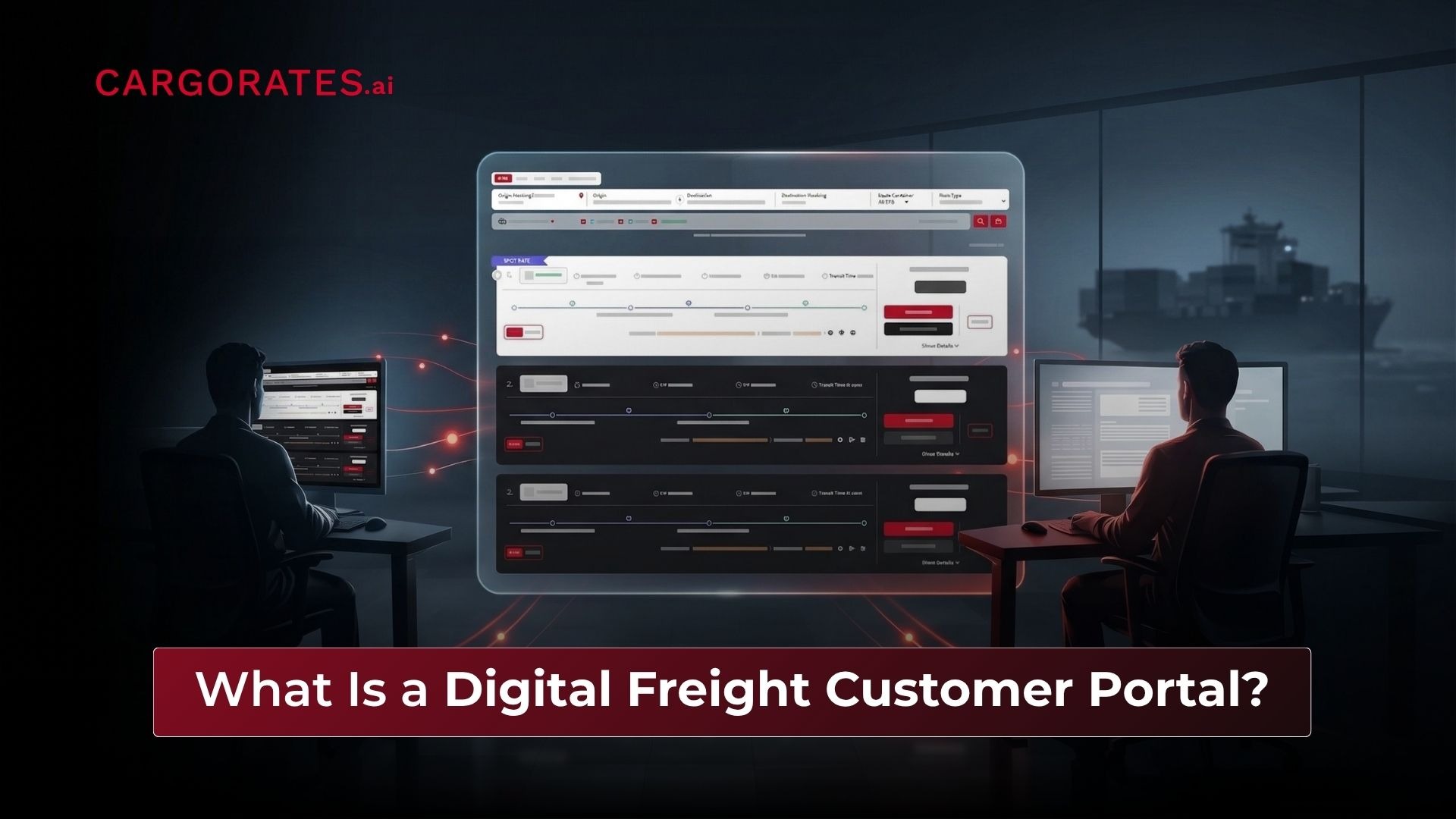
A digital freight customer portal is a persistent, branded digital environment where a shipper manages their entire freight relationship with their NVOCC or forwarder. The key word is persistent. It is not a one-time quote response, a shared tracking link, or a PDF rate sheet. It is a structured interface that the shipper returns to every time they need to interact with their freight provider, and that holds the full history of that relationship in one accessible place.
The portal is operated under the freight provider's brand, not the technology platform's brand. When a shipper logs in, they see their forwarder's name and identity. They are interacting with their logistics partner in a professional digital environment that the forwarder has made available to them. This brand ownership is commercially important: the portal strengthens the forwarder-shipper relationship rather than inserting a third party between them.
The operational purpose of the portal is to replace the manual communication cycle that currently drives up cost and response time for forwarders. Every email a shipper sends asking for a rate, an update, or a document requires a team member to read it, respond to it, or find the information and send it. A portal converts those manual touchpoints into automated, self-service actions that the shipper completes independently without generating any work for the forwarder's operations team.
A digital freight customer portal that genuinely qualifies as one must deliver six capabilities. Each one addresses a specific operational pain point for the forwarder and a specific experience requirement for the shipper. Together they define what separates a real portal from a branded front-end with limited function.
Email quoting is the default in most freight forwarding operations. A shipper sends a rate request, a pricing team member finds the applicable rate, calculates surcharges, applies margin, and sends a quote back. The shipper accepts, the booking is confirmed, the forwarder manages updates and documents by email, and the cycle repeats. It works, but it has a fundamental scaling problem: every new shipment adds proportional work to the team's load.
A digital customer portal does not improve email quoting. It replaces it. The operational difference is structural, not incremental.
The commercial consequence of this difference is not just efficiency. It is shipper experience quality. A shipper whose forwarder responds to requests in under 30 seconds through a professional branded portal and who can track their own shipments without chasing emails has a fundamentally different relationship with that forwarder than one managing freight through an inbox. The digital portal is where shipper loyalty is built or lost, independent of price.
The commercial case for a digital customer portal is built on three pressures that are structural in the current market: rising shipper expectations, the operational cost of manual communication, and the competitive disadvantage of slower response times.
Shippers who manage procurement, banking, and supplier relationships through digital portals in every other part of their business expect the same standard from their freight providers. The expectation of a self-service interface where they can get a rate, track a shipment, and download a document without making a phone call is not a premium expectation any more. It is the baseline. Forwarders who cannot offer it are operating below the standard the market expects.
For NVOCCs and forwarders serving mid-to-large shippers, this expectation has direct implications for vendor selection. Procurement teams evaluating freight providers are including digital capabilities in their assessment. A forwarder without a customer portal is a forwarder whose digital offering is invisible because it has nothing to show.
Every rate email sent, every shipment update provided, and every document attached is a manual action by a team member that does not generate revenue but does consume operational capacity. As explained in our guide on how freight forwarders can win more quotes through operational improvements, the forwarders that scale profitably are those that have decoupled operational output from team size. A digital customer portal is the primary mechanism through which the shipper communication layer is automated.
When a forwarder handles 50 active shippers entirely by email, the team's non-revenue communication load is significant. When those same 50 shippers manage their own tracking, document downloads, and booking reviews through a portal, that load disappears without any reduction in service quality.
Shippers contact multiple freight providers simultaneously when requesting rates. As detailed in the broader context of how ocean freight rate management works end to end, the forwarder that responds first with a complete, accurate quote wins a disproportionate share of business. A digital customer portal removes the intake delay entirely: the shipper's request arrives at the quoting engine structured and ready to process the moment it is submitted, rather than sitting in an inbox waiting to be read.
Without a portal, the intake step alone adds 15 to 45 minutes to the response time before any rate lookup has begun. With a portal, that delay is zero.
The Cargorates.ai Digital Customer Portal is built as a customer-facing product layer on top of the platform's full rate management, quoting, tracking, and document infrastructure. It is not a standalone module. It is the interface through which shippers interact with every capability the platform delivers.
When a shipper submits a quote request through the portal, the shipment details arrive in Cargorates.ai already structured and categorised. Origin, destination, container type, cargo description, and preferred timeline are captured in the request form and passed directly to the quoting engine. There is no manual transcription step for the forwarder's team. The platform immediately begins matching the request against available carrier rates across all loaded contracts and live spot rates.
The quote that comes back reflects every applicable carrier option on the requested lane with surcharges applied automatically through rule-based profiles and margin applied through pre-configured pricing rules. The shipper receives a complete, surcharge-inclusive, multi-carrier response in the portal without any team member having manually touched the request. For a platform handling the kind of rate search volumes described in our piece on why instant freight quoting has become operationally essential, this structural automation is what makes high daily quote volumes operationally manageable.
Cargorates.ai includes Track and Trace functionality that surfaces real-time shipment milestones inside the portal. Shippers can log in at any point and see the current status of every active shipment by container, by lane, and by milestone. Whether a shipment is at origin port, in transit, at transshipment, or approaching the destination port, that status is visible in the portal without the shipper needing to ask the forwarder's operations team for an update.
This single capability has a measurable impact on inbound call and email volume for forwarder operations teams. Status enquiries are one of the highest-volume, lowest-value communication types in freight operations. When shippers can answer those questions themselves through the portal, the team's time is freed for higher-value activities.
All shipping documentation associated with a booking is accessible in the portal for the shipper to download directly. Bills of lading, packing lists, arrival notices, and any other shipping document are held in the portal against the relevant booking record. The shipper accesses what they need without emailing the forwarder to request it. No manual document retrieval and attachment by a team member. No email trail of document versions. The document is in the portal when the shipper needs it.
The portal maintains a complete record of the shipper's quote requests, accepted rates, active bookings, and completed shipments. A shipper reviewing their freight spend, comparing rates across lanes, or preparing a procurement report can access that historical information directly in the portal without requesting a report from the forwarder. This visibility strengthens the commercial relationship by giving the shipper data about their own freight programme that previously required forwarder involvement to produce.
The Cargorates.ai Digital Customer Portal is deployed as a branded interface under the NVOCC or forwarder's identity. Shippers interact with their freight provider, not with a generic logistics technology platform. This brand ownership is operationally significant: shippers who interact with their forwarder through a professional digital portal associate that quality of experience with their forwarder, not with the underlying technology. The loyalty built through the portal experience belongs to the forwarder.
The operational case for a digital customer portal is strongest when viewed from both sides of the relationship. Forwarders benefit from the automation and efficiency gains described above. Shippers benefit from a materially better freight management experience.
For shippers evaluating multiple freight providers, the quality of this experience is increasingly a differentiating factor. A forwarder whose portal delivers all six of the above is competing on a different level than one whose digital offering is a rate email and a tracking spreadsheet.
The freight industry uses the term portal loosely. Understanding where the line is between a genuine digital customer portal and a branded communication front-end helps NVOCCs and forwarders evaluate what they are actually being offered.
| Capability | Branded rate email / basic frontend | Digital Customer Portal (Cargorates.ai) |
|---|---|---|
| Quote request intake | Shipper sends email; team manually processes it | Structured portal form; quoting engine processes automatically |
| Quote response delivery | Team member emails a formatted quote back | Platform delivers quote in portal automatically in under 30 seconds |
| Shipment tracking | Shipper emails for updates; team responds manually | Real-time Track and Trace visible in portal at all times |
| Document access | Documents emailed on request by a team member | All documents available for self-service download in portal |
| Booking management | Status communicated by email; no centralised view | Full booking lifecycle visible in portal in real time |
| Rate and booking history | No persistent history; shipper must search their own inbox | Complete history of quotes, rates, and bookings in the portal |
| Availability | Limited to team business hours | 24/7 without staff dependency |
| Brand ownership | Email is from the forwarder; branding is informal | Portal is branded under the forwarder's identity |
| Operational scaling | Each new shipper adds proportional team communication load | Higher shipper volumes handled without additional headcount |
Shipper retention is determined by a combination of pricing, reliability, and the quality of the working relationship. A digital customer portal directly improves the third factor in a way that makes the other two less decisive than they might otherwise be.
A shipper who manages their freight through a portal where quotes arrive in under 30 seconds, shipments are trackable in real time, and documents are always available has a functional workflow built around their forwarder. Switching to a new forwarder means losing that workflow, rebuilding the relationship from scratch, and returning to email-based communication if the new provider does not offer an equivalent portal experience. This operational friction is a genuine retention mechanism that operates independently of price competitiveness.
The portal also creates visibility that prevents relationship-damaging surprises. A shipper who can see their shipment's current status in real time is less likely to be blindsided by a delay than one who only receives updates when they ask for them. Proactive visibility through the portal reduces the number of complaints and disputes that erode the commercial relationship over time.
For NVOCCs managing a customer base of BCOs and shippers, the portal adds an additional value layer. As covered in the context of how the Cargorates.ai platform supports NVOCCs and freight forwarders across the full quoting and shipment lifecycle, the digital customer portal is the customer-facing expression of the platform's operational capabilities. Every quote generated, every shipment tracked, and every document made available through the portal is evidence to the shipper that their forwarder is running a professional, technology-enabled operation.
For NVOCCs and freight forwarders evaluating platform options, these are the capabilities that determine whether a digital customer portal will deliver its commercial and operational promise.
| Capability to evaluate | Why it matters | What to ask |
|---|---|---|
| Structured quote request intake | Eliminates manual transcription at intake; enables automated quoting | Does the portal capture structured shipment data, or does it forward an email? |
| Automated quote delivery | Response time is the key win rate driver; automation is what enables sub-30-second responses | Is the quote generated and delivered automatically, or does a team member need to send it? |
| Real-time shipment tracking | Reduces inbound status enquiry volume; improves shipper experience | Can the shipper track their own shipments in the portal without calling? |
| Document self-service | Eliminates document request emails; saves team time per shipment | Can the shipper download their own documents from the portal at any time? |
| Branding under your identity | Brand ownership of the shipper experience strengthens the relationship | Is the portal deployed under your brand, or under the vendor's brand? |
| 24/7 availability | Shippers operate across time zones; business-hours-only portals are incomplete | Is the portal fully functional outside your team's working hours? |
| Integration with the rate management platform | A portal disconnected from the rate management engine produces manual workarounds | Is the portal built on top of the same platform that manages your rates, or a separate module? |
The Cargorates.ai Digital Customer Portal satisfies all seven of these criteria. It is built on the same platform that manages carrier contracts, spot rates, surcharge automation, vessel schedules, and Track and Trace, which means every capability the portal surfaces to the shipper is powered by the same operational infrastructure the forwarder's team uses. There is no disconnection between what the portal shows and what the platform knows.
For forwarders looking at the full picture of how a rate management platform and a customer portal work together to support better quoting and a better shipper experience, the comparison between freight rate offer approaches covers how the combination of rate visibility and customer-facing delivery changes the competitive dynamic entirely.
A digital freight customer portal is a branded, self-service online interface that allows a shipper to request freight quotes, track active shipments, download shipping documents, and manage bookings directly with their freight provider without using email or phone. It is operated under the NVOCC or freight forwarder brand and replaces fragmented email communication with a structured, always-available digital workflow.
A digital freight customer portal should deliver at minimum six capabilities: self-service quote requests, real-time shipment tracking, document access and download, booking management, rate history visibility, and 24/7 availability without requiring an operations team member to respond. Each of these removes a manual touchpoint from the forwarder's workflow while improving the shipper's experience.
A rate email is a one-time, manually created response to a single shipper request. A freight customer portal is a persistent, structured digital environment where the shipper manages their entire freight relationship: requesting quotes, receiving responses, tracking shipments, downloading documents, and reviewing their pricing history, all without generating manual work for the forwarder's team. Email quoting scales with headcount. A portal scales without it.
A digital customer portal reduces operational cost by automating the manual intake, response, and update steps that currently require team member time. Quote requests arrive structured and ready to process without transcription. Shipment updates are delivered automatically without customers calling operations. Documents are downloaded by the shipper directly without being emailed manually. Each automated touchpoint reduces the cost per shipment handled without reducing service quality.
Yes. The Cargorates.ai Digital Customer Portal is deployed under the NVOCC or freight forwarder's own brand. Shippers interact with the portal as a product of their freight provider, not as a Cargorates.ai interface. This means the forwarder retains full brand ownership of the shipper relationship while benefiting from the platform's automation capabilities underneath.
Yes. Cargorates.ai includes Track and Trace functionality that gives shippers real-time visibility of their active shipments by lane, container, and milestone. Shippers can log into the portal and see the current status of any shipment without calling the forwarder's operations team. This directly reduces inbound status enquiry volume for the forwarder.
A TMS shipper login is typically a data access function that allows shippers to view booking records inside the forwarder's internal system. A digital customer portal is designed as a customer-facing product with a clean, branded interface built around the shipper's workflow needs: requesting quotes, tracking shipments, and accessing documents. Cargorates.ai's Digital Customer Portal is purpose-built as a customer experience layer, not a backend data view.
Shippers who manage their freight through a structured digital portal where quotes are received in under 30 seconds, shipments are trackable in real time, and documents are always accessible are significantly less likely to switch providers than shippers managing freight through email. The portal creates a functional dependency on the forwarder's digital environment that strengthens the commercial relationship independent of price alone.
See how the Cargorates.ai Digital Customer Portal gives NVOCCs and freight forwarders a branded, self-service shipper interface that responds in under 30 seconds and handles tracking, documents, and bookings without your team.
Schedule a Demo