Blog

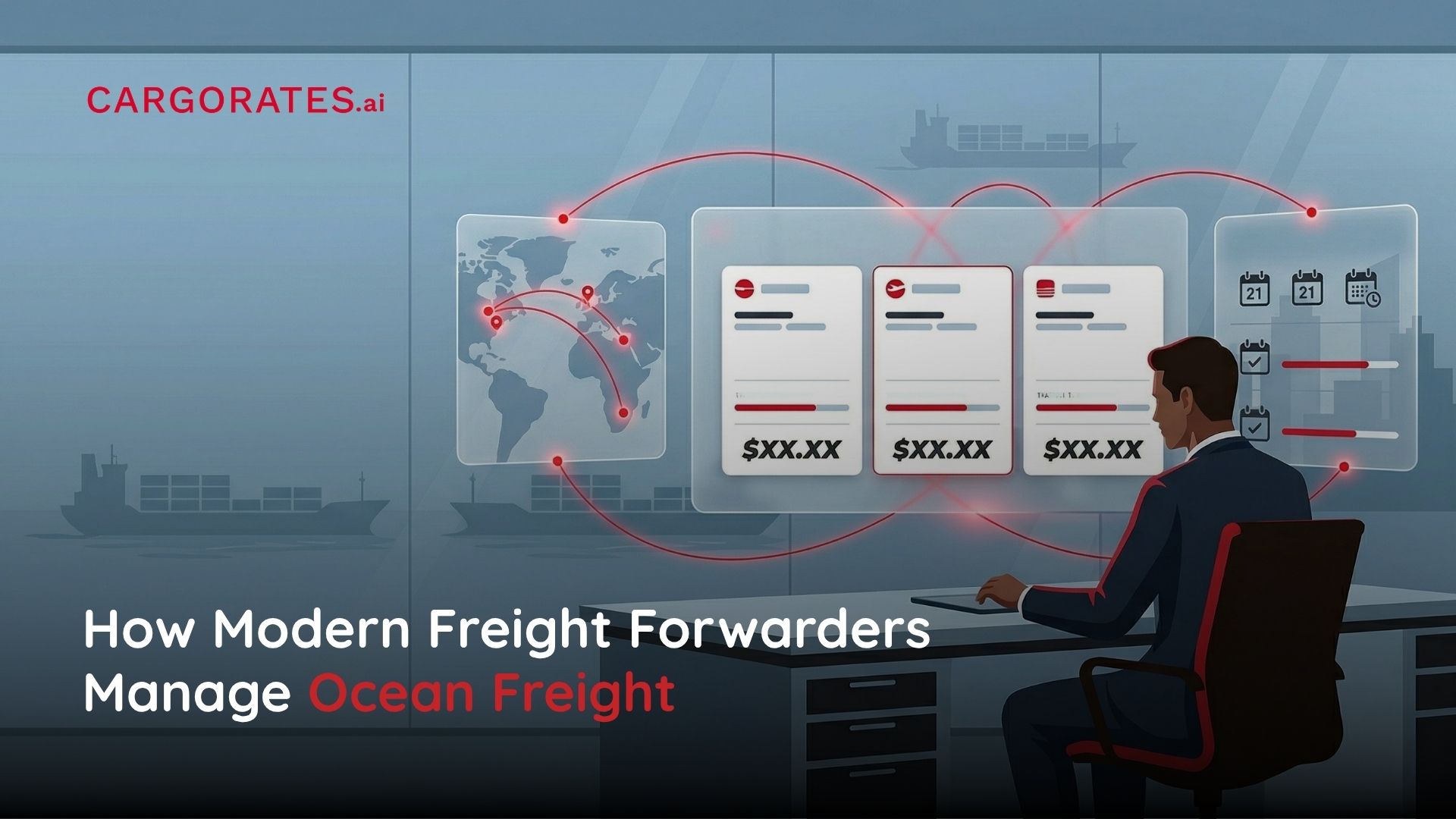
Modern freight forwarders manage ocean freight through AI-powered rate management platforms that centralise all carrier contracts in one system, automate surcharge profiles so every quote is complete and invoice-accurate, compare multiple carriers in real time, and deliver instant quotes in under 30 seconds. They replace the manual cycle of searching email archives, checking PDF rate sheets, and calculating surcharges by hand with a fully automated quoting workflow. A branded digital customer portal removes the email intake step entirely, allowing shippers to submit requests and receive responses without any manual handling. This is what separates operationally excellent freight forwarders from those still competing on manual processes in a market where response speed determines who wins the business.
The freight forwarding industry has always been operationally demanding. Managing carrier relationships, navigating shifting surcharge structures, matching shippers to the right routing across dozens of trade lanes, and doing all of it faster than the competition requires a level of operational infrastructure that spreadsheets and email simply cannot provide at scale.
The best freight forwarders in operation today have recognised this and built their quoting and rate management workflows around purpose-built technology. They are not moving faster because they hired more people. They are moving faster because the tools they use handle the repetitive, error-prone layers of rate management automatically, leaving their teams to focus on decisions rather than data entry.
This guide covers the complete workflow of how modern freight forwarders manage ocean freight, from rate sourcing through to customer delivery, and what the platform infrastructure behind that workflow actually does.
To understand what modern freight forwarders do differently, it helps to be precise about what the traditional workflow looks like and where it fails.
A traditional freight forwarder manages carrier rates through a combination of email inboxes, PDF attachments, and spreadsheet files. When a carrier sends an updated rate sheet, it arrives as a file that needs to be saved, organised, and manually entered into whichever internal system the team uses. When a shipper sends a quote request, a pricing team member must locate the applicable rate file, verify the rate is still valid, manually add surcharges from a separate table, calculate the margin, format the response, and send it by email.
This process has five failure points built into it. Rates expire without automatic alerts, so teams quote from outdated files. Surcharges change faster than manual tables are updated, so quotes are frequently incomplete. Different team members apply margin inconsistently under time pressure. Multi-carrier comparisons require repeating the entire process for each carrier, which is rarely done when time is short. And the whole cycle typically takes two to eight hours per quote in an environment where shippers contact multiple providers simultaneously and book with whoever responds first.
The consequences are commercial and operational. Slower response times mean lower quote win rates. Surcharge errors mean invoice disputes. Inconsistent margin application means profitability leakage across the quote book. None of these are small problems, and none of them are solved by working harder within the same manual process.
Modern freight forwarders have replaced each manual step in the traditional workflow with a platform-driven equivalent. The result is a quoting and rate management cycle that runs faster, produces fewer errors, and scales without proportional headcount growth.
All carrier contracts are uploaded to a single rate management platform, structured by trade lane, container type, validity period, and carrier. When a carrier sends an updated rate sheet, the new version is uploaded and the previous version is archived with its full date record. No rate file sits in an email inbox waiting to be processed. No expired contract remains available for quoting because version control and expiry alerts are managed at the system level. The entire carrier rate portfolio is queryable in real time without any manual search.
Surcharge profiles are attached to each carrier contract at the point of upload, not calculated manually when a quote is being assembled. BAF (Bunker Adjustment Factor) tables are linked to the carrier and trade lane. PSS (Peak Season Surcharge) windows are set by season. THC (Terminal Handling Charges) are configured by origin and destination port. When a quote is generated, every applicable surcharge is applied automatically based on the carrier, lane, container type, and current date. The quoted price matches the invoiced price by design rather than by luck.
Modern forwarders do not default to contracted rates without checking spot market conditions. The rate management platform surfaces real-time spot rates from multiple carriers alongside stored contracted rates in a single comparison view. This means the forwarder can always present the shipper with the most competitive option available at the time of the request, whether that is a contracted rate or a spot rate, without needing to check separate portals or call carrier pricing desks.
When a shipper request arrives, the platform searches all available carrier options on the requested trade lane simultaneously. Margin rules are pre-configured by lane, carrier, customer segment, or container type, and applied automatically to every quote the system generates. No team member calculates margin on a per-quote basis. No pricing decision is made under time pressure by whoever happens to handle the request. The complete, surcharge-inclusive, margin-applied quote is ready in under 30 seconds.
A freight quote is not complete without routing information. Transit time, departure dates, transshipment points, and sailing schedules are part of what a shipper needs to make a booking decision. Modern forwarders integrate live vessel schedules directly into the quoting workflow, so the platform delivers a routing-complete quote in one step. The shipper receives price, carrier, transit time, and departure options together rather than waiting for a follow-up response with schedule details.
Before a quote can be generated, a request must be received and processed. In a manual operation, this means reading an email, interpreting its content, and transcribing shipment details into the quoting system before any rate lookup begins. Modern forwarders replace this intake step entirely by providing shippers with a branded digital customer portal where requests are submitted in a structured form. The shipment details arrive at the quoting engine already structured, and the automated quoting cycle begins immediately without any manual handling. The same portal delivers the completed quote back to the shipper, tracks their active shipments in real time, and gives them access to shipping documents without further contact with the forwarder's team.
Full Container Load rates are the operational core of ocean freight for most freight forwarders and NVOCCs. FCL rate management involves structuring, storing, and applying carrier pricing for 20ft and 40ft containers across trade lanes, with different rates by carrier, container type, and validity period.
In a manual operation, FCL rate management means maintaining multiple spreadsheet files for multiple carriers, manually updating them when rate amendments arrive, and searching across them when a quote request comes in. The failure rate in this process is high: rates expire unnoticed, amendments overwrite the wrong version of a file, and surcharge tables drift out of sync with the rates they are meant to apply to.
In a platform-driven operation, every FCL contract is uploaded, versioned, and associated with a complete surcharge profile at the point of entry. The rate is then immediately queryable for any trade lane and container type without further manual work. When the carrier sends an amended rate mid-contract, the amendment is uploaded as a new version and the system flags any quotes in progress that may need to be updated. The detailed mechanics of how this structure works in practice, including how lanes, container types, and validity periods are organised within a rate management system, are covered in our piece on how to structure, store, and apply FCL rate management for modern forwarding operations.
Freight forwarders who work exclusively from contracted rates are leaving value on the table. Ocean freight spot markets fluctuate with carrier capacity, demand cycles, trade lane disruptions, and seasonal peaks. There are periods when spot rates offer genuinely better value than a contracted rate negotiated six months earlier, and forwarders who cannot identify those windows cannot pass the saving on to their shippers.
Modern freight forwarders maintain access to real-time spot rates as a standard part of their rate management infrastructure. This is not a separate process from contract management. Both spot and contracted rates live on the same platform, and at the moment of quoting, the system shows both options side by side. The forwarder can then present the shipper with a genuine market comparison rather than defaulting to a single carrier rate without context.
The decisions involved in choosing between spot and contracted ocean freight rates, including when spot rates offer better value and how to factor in capacity security, are a fundamental part of modern ocean freight procurement. Understanding when and how to use each rate type is one of the areas where sophisticated forwarders consistently differentiate themselves from more transactional competitors.
The operational improvements that modern freight forwarders achieve through platform-driven rate management translate directly into commercial outcomes. The connection between faster quoting, higher accuracy, and better win rates is well understood but often underestimated in scale.
Shippers requesting ocean freight rates typically contact multiple providers simultaneously. The forwarding operation that responds first with a complete, accurate, multi-carrier quote captures the shipper's attention before any competitor has responded. The forwarding operation that responds eight hours later is competing from a disadvantaged position regardless of how competitive its pricing is.
The impact compounds in two directions. Faster quoting increases win rate from the same enquiry volume. Accurate surcharge management reduces invoice disputes and the re-quoting cycles that follow them. Together, these improvements change the economics of the forwarding operation. More of the same enquiry volume becomes revenue, and less of the team's time is consumed by error correction and dispute resolution. The specific operational factors that drive these improvements in quote win rate, and how each one maps to a platform capability, are covered in detail in our analysis of the operational factors that determine freight forwarder quote win rate.
For forwarders and NVOCCs looking at the full picture of what a modern rate management platform makes possible across the quoting and customer service workflow, the capabilities available through Cargorates.ai for NVOCCs and freight forwarders cover each functional area in a single overview.
| Operational Area | Traditional Forwarding | Modern Platform-Driven Forwarding |
|---|---|---|
| Rate storage | PDF and Excel files in email and shared drives; no version control | Centralised platform with full version history, expiry alerts, and instant query access |
| Surcharge management | Calculated manually from separate surcharge tables at quoting time; frequently outdated | Surcharge profiles attached to each rate at upload; applied automatically on every quote |
| Spot rate access | Checked manually on carrier portals or by phone; separate from contract rate workflow | Real-time spot rates displayed alongside contracted rates in one comparison view |
| Multi-carrier comparison | Manual process repeated for each carrier; rarely completed under time pressure | All contracted carriers compared simultaneously; best option identified in one view |
| Quote generation | Manual: rate lookup, validity check, surcharge calculation, margin application, email formatting | Automated: complete surcharge-inclusive, margin-applied quote in under 30 seconds |
| Vessel schedule | Checked separately on carrier websites; added to quote as a manual follow-up | Live sailing schedules integrated into the quote workflow; routing included in first response |
| Quote intake | Shipper emails a request; team member reads and manually transcribes to quoting system | Shipper submits via branded portal; request arrives structured and immediately actionable |
| Shipment tracking | Shippers call or email for status updates; team member checks and responds manually | Shippers track active shipments in real time through the portal without contacting the team |
| Analytics and intelligence | No systematic data capture; carrier performance and lane competitiveness assessed informally | Smart Reports provides lane-level analytics, carrier performance data, and rate trend dashboards |
| System integration | Manual data re-entry between quoting tools and TMS or ERP | EDI and API integration connects platform to TMS and ERP; data flows automatically |
Every operational improvement described in this guide flows from one foundational change: the move from fragmented, manually managed rate data to centralised, automatically governed rate infrastructure.
Ocean freight rate management is not a single task. It is the entire end-to-end process of sourcing carrier pricing, structuring it so it is accessible at quote time, governing its validity, applying surcharges correctly, and using the resulting quote data to make better procurement decisions over time. When that process is managed manually, every stage introduces delay, error risk, and inconsistency. When it is managed through a purpose-built platform, every stage runs faster and with fewer failure points.
The comprehensive framework for how ocean freight rate management works across all its components, including how spot rates, contract rates, surcharge management, and carrier governance interact across the full freight forwarding workflow, is covered in our complete guide to ocean freight rate management for NVOCCs, forwarders, and BCOs.
Cargorates.ai is built around the specific operational requirements of NVOCCs and freight forwarders managing ocean freight at scale. Every capability in the platform maps directly to one of the manual steps that the modern forwarding workflow has replaced.
Contract rates from every carrier are uploaded, version-controlled, and queryable by trade lane, container type, and validity period. Surcharge profiles are attached at the rate entry stage so BAF, PSS, THC, GRI, and CAF are applied automatically on every quote. Real-time spot rates are surfaced alongside contracted rates for comparison at the moment of quoting. Live vessel schedules are integrated into the quoting workflow so routing information is part of the first response. Margin rules are pre-configured at the platform level so every quote reflects the same intentional pricing logic regardless of which team member generates it.
The Digital Customer Portal removes the intake bottleneck by giving shippers a branded interface where they submit structured quote requests, track their active shipments in real time, and access shipping documents without contacting the forwarding team. Smart Reports converts the daily quoting activity into lane-level analytics that forwarders use to identify where their pricing is most competitive and where carrier negotiations should focus at renewal time.
EDI and API integration connects Cargorates.ai to existing TMS and ERP systems so rate data, booking records, and shipment information flow between platforms without manual re-entry. The Smart Chatbot handles rate enquiries and container tracking requests around the clock without requiring a team member to respond, which is particularly valuable for forwarders serving shippers across multiple time zones.
Forwarders using Cargorates.ai report responding 12 to 15 times faster to RFQs and achieving 45 to 50 percent improvements in quote win rate. The platform processes over 1,000 daily rate searches. Cargorates.ai was recognised by Corporate Vision as the Best AI-Powered Freight Rate Management Platform in India in 2025 and is powered by Info-X Software Technology Pvt. Ltd., a freight technology company with over 20 years of industry expertise.
For freight forwarders evaluating what a modern rate management platform needs to deliver for their shippers, including what capabilities should be available through a customer-facing portal and what the minimum viable portal experience looks like, the full breakdown is in our guide on what a digital freight customer portal should do and how to evaluate one.
The operational gap between freight forwarders running modern platform-driven workflows and those still managing rates manually is widening, not closing. The volume of ocean freight rate data, the pace at which surcharge structures change, and the speed at which shippers now expect responses have all increased to the point where manual management is not a slower version of the modern approach. It is a structurally different operational model with a lower ceiling on both volume and quality.
Modern freight forwarders get three things right that manual operations consistently miss. They make rates complete before the quoting stage by attaching surcharge profiles at upload rather than calculating them per quote. They make rates comparable by holding all carrier options in one system rather than searching portals sequentially. And they make rates fast by generating quotes automatically rather than requiring a team member to assemble each one from scratch.
These three capabilities, taken together, change the position a freight forwarder occupies in the market. They shift the competition from who has the best carrier relationships to who has the best operational infrastructure. And in ocean freight, operational infrastructure is increasingly the only durable competitive advantage.
Modern freight forwarders manage ocean freight rates through a centralised AI-powered rate management platform that stores all carrier contracts in one place, applies surcharges automatically through rule-based profiles, compares multiple carriers in real time, and generates complete instant quotes in under 30 seconds. This replaces the manual process of searching email archives, PDF attachments, and spreadsheets that characterised earlier freight forwarding operations.
Traditional freight forwarders manage rates through a combination of email, PDF rate sheets, and spreadsheets. Quote generation requires a team member to manually locate the applicable carrier rate, verify its validity, calculate surcharges separately, apply margin, and format the response. This takes two to eight hours per quote. Modern freight forwarders use a rate management platform where all carrier contracts are centralised, surcharges are automated, and quotes are generated in under 30 seconds with margin applied automatically.
Freight forwarders need a rate management platform because the volume and complexity of ocean freight pricing data cannot be managed effectively with manual tools at scale. A modern forwarder may manage contracts with 15 to 30 carriers across dozens of trade lanes, each with monthly BAF updates, seasonal PSS windows, and per-port THC tables. Without a platform, rates expire without alerts, surcharges are missed, version control is impossible, and quote response times fall far behind what shippers expect.
Modern freight forwarders handle surcharges by attaching surcharge profiles to each carrier rate entry at the point of upload, not at the quoting stage. Platforms like Cargorates.ai associate BAF tables by carrier and trade lane, PSS windows by season, and THC by port. When a quote is generated, all applicable surcharges are applied automatically based on the shipment date, container type, and routing. This closes the gap between quoted price and invoiced amount that causes invoice disputes.
Modern freight forwarders provide instant freight quotes by using a rate management platform where all carrier contracts are pre-loaded, surcharge profiles are pre-configured, and margin rules are set at the system level. When a shipper submits a quote request through a digital customer portal, the platform searches all available carrier rates on the requested lane simultaneously, applies surcharges and margin automatically, and delivers a complete multi-carrier quote in under 30 seconds without manual intervention.
Carrier comparison is one of the most commercially valuable capabilities a modern freight forwarder can offer. Rather than quoting a single carrier on a trade lane, a forwarder with a rate management platform can present a shipper with multiple carrier options side by side, showing price, transit time, routing, and surcharge-inclusive totals for each. This gives shippers more information to make a decision and demonstrates that the forwarder has true market coverage across multiple carriers, not just a relationship with one or two.
FCL rate management is the operational core of ocean freight forwarding for most NVOCCs and forwarders. It involves storing, versioning, and applying Full Container Load rates from multiple carriers by trade lane, container type, and validity period, with surcharge profiles attached. Modern FCL rate management requires a platform that handles contract upload and version control, flags expiry dates automatically, and makes all carrier rates instantly queryable at the time of quoting.
Cargorates.ai is an AI-powered freight rate management platform that gives freight forwarders and NVOCCs centralised contract and spot rate management, automated surcharge profiles, instant multi-carrier quote generation, live vessel schedule integration, a branded Digital Customer Portal for shippers, Smart Reports with lane-level analytics, and EDI and API integration with TMS and ERP systems. Forwarders using the platform report responding 12 to 15 times faster to RFQs and improving quote win rates by 45 to 50 percent.
See how Cargorates.ai gives freight forwarders and NVOCCs the rate management infrastructure to centralise carrier contracts, automate surcharges, and quote in under 30 seconds across every trade lane.
Schedule a Demo