Blog

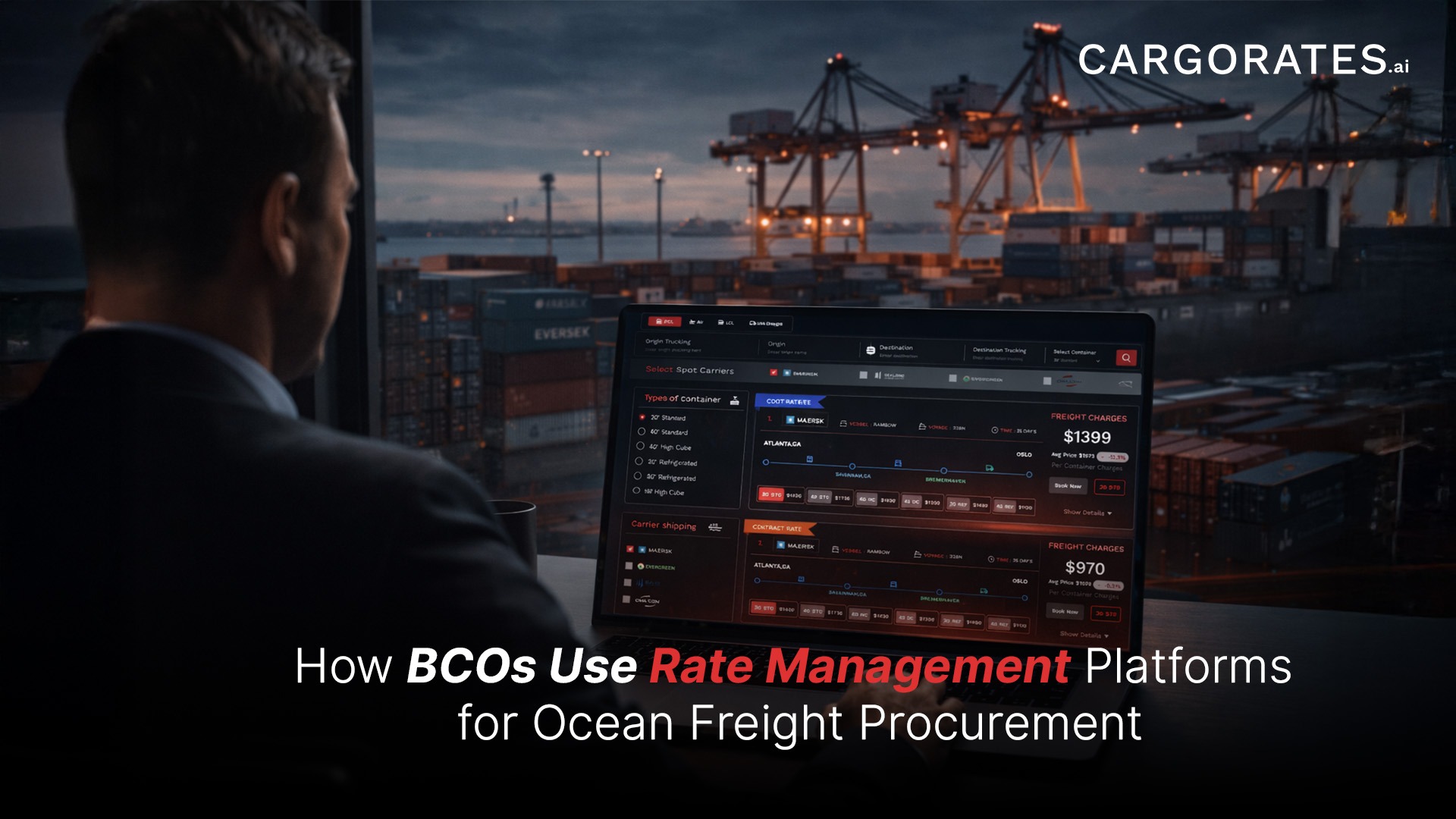
Beneficial Cargo Owners use rate management platforms to manage the full ocean freight procurement cycle: storing and comparing carrier contract bids, tracking contracted allocation utilisation by trade lane, benchmarking contracted rates against live spot market rates, and building the lane-level analytics needed to negotiate better contracts at renewal. Unlike freight forwarders who use rate platforms primarily for quoting speed, BCOs use them as a procurement intelligence tool. Cargorates.ai supports BCO procurement through centralised contract rate storage, real-time spot rate comparison, Smart Reports for lane-level analytics, and EDI integration with TMS and ERP systems.
Beneficial Cargo Owners occupy a distinct position in ocean freight. They are not in the business of quoting shipments to customers. They are in the business of securing the best possible contracted rates from ocean carriers and NVOCCs and then managing those contracts across the full year to ensure their freight spend delivers the value that procurement agreed to.
This is a procurement function, and it requires a different set of tools from what a freight forwarder uses to quote a customer. The BCO's priority is not response speed. It is contract quality, rate visibility, allocation discipline, and the analytical infrastructure to improve on the last tender cycle when the next one arrives.
A rate management platform built for BCOs gives procurement teams exactly this infrastructure. This guide covers the BCO ocean freight procurement workflow, the specific ways a platform supports each stage, and how Cargorates.ai delivers these capabilities for Beneficial Cargo Owners.
The most important thing to understand about BCO rate management is that it is not a faster version of what freight forwarders do. It is a different workflow entirely.
A freight forwarder receives a shipment request from a customer and needs to generate a competitive quote in the shortest possible time. Their rate management challenge is speed and accuracy at the individual shipment level. A BCO does not quote customers. They negotiate contracts directly with ocean carriers and NVOCCs, commit to volume allocations on specific trade lanes, and then manage whether those allocations are being used correctly over the contract period.
The BCO's rate management challenge is strategic and longitudinal. It is about getting the right contracted rates in the first place, then ensuring those contracts are delivering value across their full validity period, and arriving at the next tender cycle with data strong enough to negotiate from a position of knowledge rather than assumption.
BCO ocean freight procurement operates in cycles that broadly follow the annual or multi-cycle contract calendar of major ocean carriers. Understanding the four stages of this cycle is the foundation for understanding what a rate management platform needs to do to support it.
The BCO issues a Request for Quotation to ocean carriers and NVOCCs covering their key trade lanes, volume forecasts, and service requirements. Carrier bids arrive in various formats: PDF, Excel, email, EDI. The platform's job at this stage is to centralise all incoming bids in a structured, comparable format so the procurement team can evaluate them side by side rather than across a stack of disparate files.
Once carrier bids are evaluated and contracts are awarded, the agreed rates need to be stored in the platform in a structured, queryable format with clear validity periods, lane coverage, container type specifications, surcharge tables, and allocation commitments. This is where most BCO procurement processes break down without a platform: awarded contracts sit in email threads and shared drives, and by the time the contract year is halfway through, no one can locate the most recent version.
Most ocean freight contracts include volume commitments on specific trade lanes. The BCO commits to shipping a certain number of TEUs with a specific carrier in exchange for guaranteed space and preferential rates. Active monitoring of how much of that allocation is being used, by lane and by carrier, is critical. Under-utilisation leaves contracted capacity unused and weakens the BCO's negotiating position at renewal. Over-utilisation forces spot market purchases at unfavourable rates.
Throughout the contract period and especially as the next tender cycle approaches, BCOs need to benchmark their contracted rates against current spot market conditions on the same trade lanes. This comparison answers the question procurement leadership always asks: are we paying the right price? If contracted rates are consistently above spot, it is a signal to push harder in the next negotiation. If contracted rates are below spot, the contracts are delivering real value that needs to be protected.
Each stage of the BCO procurement cycle maps to a specific platform capability. A rate management platform that serves BCO procurement effectively must deliver all four.
| BCO Procurement Stage | Platform Capability Required | What Breaks Without It |
|---|---|---|
| Tender management | Bulk contract upload from multiple formats; structured carrier bid comparison | Procurement team evaluates bids manually from disparate files; comparison is slow and error-prone |
| Contract award and storage | Version-controlled contract repository with validity dates, lane coverage, and surcharge profiles | Awarded contracts are stored in email and shared drives; outdated versions are used; surcharges are missed |
| Allocation monitoring | Lane-level utilisation tracking against committed volume; real-time visibility of allocation consumption | BCO discovers under or over-utilisation only at renewal; loses negotiating leverage or faces unplanned spot costs |
| Rate benchmarking | Real-time spot rate access for comparison against contracted rates; historical trend analytics by lane | Benchmarking is done ad hoc; procurement enters negotiations without data; contracts are renewed at unfavourable rates |
Cargorates.ai is built to serve both the operational quoting workflows of NVOCCs and forwarders and the strategic procurement workflows of BCOs. The platform delivers the specific capabilities that BCO procurement teams need across each stage of the contract cycle.
BCO procurement teams deal with a high volume of contract documents across multiple carriers, trade lanes, and contract periods. Cargorates.ai allows all carrier contracts to be uploaded to a single centralised platform, structured by trade lane, container type, validity period, and carrier. When a carrier sends an amended rate sheet mid-contract, the new version is uploaded and the previous version is archived with its full date record intact.
This version control discipline is one of the most operationally important capabilities for BCOs. In a freight procurement operation managed by email and spreadsheets, contract amendments get lost in threads, and procurement teams often work from the wrong version without realising it until a discrepancy surfaces at invoice time. Centralised, version-controlled storage eliminates this entirely.
Understanding how this contract structure works in practice is covered in detail in our guide on how to structure, store, and apply FCL contract rates, which walks through the data architecture that makes contract rates consistently accessible and correctly applied.
Benchmarking requires access to current market rates, not historical estimates. Cargorates.ai surfaces real-time spot rates from multiple carriers on any trade lane, allowing BCO procurement teams to compare their contracted rates against live market pricing at any point in the contract cycle.
This comparison is not just useful at tender time. It is most valuable in the middle of a contract year, when procurement leadership wants to know whether current contracts are delivering value or whether a particular carrier is underperforming on a lane where market rates have moved significantly. With live spot rate access built into the platform, that question can be answered in seconds rather than requiring a manual market survey.
The Cargorates.ai Smart Reports feature converts the platform's stored contract and rate data into lane-wise analytics and procurement dashboards. For BCO teams preparing for a carrier negotiation or a new tender cycle, this is where the platform creates its most distinctive value.
Smart Reports allows procurement teams to see which carriers have been consistently competitive on specific lanes over time, where contracted rates have tracked above or below spot conditions, and where allocation utilisation has been highest or lowest. This historical pattern analysis is exactly the intelligence that procurement teams need to enter negotiations with a data-backed position rather than a general impression.
The same analytical infrastructure that helps forwarders understand their quote win patterns, as discussed in our guide on the operational factors that drive freight forwarder quote win rates, gives BCO procurement teams visibility into the trade lane dynamics that should shape their next contracting decisions.
One of the most persistent gaps in BCO freight procurement is the distance between the linehaul rate in a carrier contract and the all-in cost of actually shipping a container on that lane. BAF (Bunker Adjustment Factor) tables change monthly. PSS (Peak Season Surcharge) is applied seasonally. THC (Terminal Handling Charges) vary by port. Without a platform that attaches current surcharge profiles to each contract entry, a BCO's contracted rate is a partial cost figure, not a complete one.
Cargorates.ai handles surcharges at the rate entry stage. When a carrier contract is uploaded, the applicable surcharge profile is associated with it: BAF tables linked to carrier and trade lane, PSS windows set by season, THC configured by port. This means any rate query against that contract returns the complete, all-in cost rather than just the linehaul component. For BCO procurement teams managing total freight spend, this completeness is not a minor operational convenience. It is the foundation of any meaningful cost comparison.
BCO procurement is not purely about rate negotiation. It is also about service quality, and transit time is one of the most commercially important service dimensions for shippers managing supply chain schedules. Cargorates.ai integrates live vessel schedules into the rate management workflow, allowing BCO teams to evaluate carrier options on transit time alongside rate, rather than treating routing decisions as a separate step.
When a procurement team is deciding whether to award additional allocation to a particular carrier on an Asia-Europe lane, the ability to see how that carrier's sailing schedule compares to alternatives in terms of transit time, transshipment stops, and port coverage is a meaningful input to the decision. Vessel schedule integration brings this information into the same platform view as the rate comparison.
BCO procurement does not operate in isolation from the rest of the business. Contracted rates feed into TMS booking workflows. Freight spend data flows into ERP financial reporting. Shipment data connects to supply chain planning systems. A rate management platform that cannot share data with these systems creates a fragmented technology stack where procurement teams spend operational time on manual data reconciliation rather than strategic analysis.
Cargorates.ai supports EDI and API integration with TMS, ERP, and CRM systems, ensuring that contracted rates, booking confirmations, and shipment data flow automatically between the rate management platform and the BCO's existing operational infrastructure. This integration is what makes the platform a genuine part of the procurement stack rather than a standalone tool that procurement teams consult and then manually transfer data from.
For BCOs managing freight across multiple trade lanes and carriers, shipment visibility is a continuous operational requirement. Knowing whether a contracted carrier is delivering on its service commitments in real time, rather than after the fact, is an important input to carrier performance management. Cargorates.ai's Track and Trace functionality provides multimodal, real-time shipment tracking across ocean, air, and domestic freight, giving BCO logistics teams the visibility they need without requiring separate tracking tools for each carrier or mode.
The practical difference between BCO procurement managed by email and spreadsheet versus procurement managed through a dedicated rate management platform is best understood at each stage of the cycle.
| Procurement Activity | Manual Process | Cargorates.ai Platform |
|---|---|---|
| Receiving carrier bids | Bids arrive as PDF and Excel via email; team manually reformats for comparison | Contracts uploaded in bulk; platform structures data for immediate side-by-side comparison |
| Storing awarded contracts | Saved in shared drives and email folders; no version control; amendments get lost | Centralised repository with full version history; amendments archived automatically with date record |
| Tracking surcharges | BAF and other surcharge tables managed in separate spreadsheets; frequently outdated | Surcharge profiles attached to each contract entry; updated centrally and applied automatically |
| Monitoring allocation utilisation | Tracked manually in spreadsheets; often reviewed only at contract renewal | Lane-level utilisation data visible in Smart Reports dashboards in real time |
| Benchmarking against spot | Ad-hoc spot market survey conducted at tender time; no ongoing visibility | Real-time spot rates available for comparison against contracted rates at any time |
| Preparing for tender negotiations | Procurement team relies on memory and partial historical data | Smart Reports provides lane-level historical rate and utilisation analytics as negotiating evidence |
| Connecting to TMS and ERP | Manual data export and re-entry across systems | EDI and API integration; data flows automatically between platform and existing systems |
It is worth addressing a question that comes up in BCO technology evaluation: why not simply use the same rate management tools that freight forwarders use?
Most freight rate platforms on the market are designed around the forwarder's workflow: fast quote generation, customer portal delivery, and margin application. These are the capabilities that freight forwarders need to compete for individual shipment business. They are not the capabilities that BCO procurement teams need to run a structured annual contract cycle.
BCO procurement requires contract bid management, allocation tracking, procurement analytics, and ERP integration. A platform built around quoting speed can store contracts, but it will not give a BCO procurement director the lane-level analytics needed to walk into a carrier negotiation with a data-backed position.
Cargorates.ai is built to serve both workflows. The same platform that helps forwarders quote in under 30 seconds also gives BCO procurement teams the contract management infrastructure, benchmarking visibility, and Smart Reports analytics that strategic freight procurement requires. This dual capability means BCOs who work with forwarder partners using Cargorates.ai are operating within a consistent platform environment, which simplifies the data flow between procurement and execution across the supply chain.
For a broader view of how the platform supports different user types across the logistics chain, the Cargorates.ai rate management platform overview covers the capabilities available to BCOs, NVOCCs, and freight forwarders in a single reference.
For BCO procurement teams evaluating rate management platforms, these are the capability areas that determine whether a platform will genuinely support the procurement cycle or simply add a layer of complexity on top of the existing spreadsheet-and-email workflow.
| Capability Area | Why It Matters for BCOs | What to Ask |
|---|---|---|
| Contract repository and version control | BCOs manage multiple contracts across multiple carriers; outdated versions must be impossible to use | Does the platform archive previous contract versions and flag expiry proactively? |
| Surcharge completeness | Contracted rates without surcharges are incomplete cost data; BCO spend analysis is distorted | Are surcharge profiles attached to contracts at upload, not calculated manually at query time? |
| Live spot rate comparison | Ongoing benchmarking requires current market rates, not monthly estimates | Can the team compare contracted rates against real-time spot rates on any lane at any time? |
| Procurement analytics | Tender negotiations require historical data; without analytics, BCOs negotiate on instinct | Does the platform provide lane-level rate trend analytics and utilisation dashboards? |
| TMS and ERP integration | Rate data that cannot flow to operational systems creates manual reconciliation overhead | What EDI and API integrations does the platform support for TMS and ERP connectivity? |
| Multi-carrier and multi-modal support | BCOs managing ocean, air, and domestic freight need a unified platform, not multiple systems | Does the platform support FCL, LCL, air, and domestic trucking rates in a single interface? |
| Vessel schedule integration | Transit time is a carrier performance metric that belongs in procurement analysis | Are live sailing schedules integrated into rate comparisons, or is schedule data sourced separately? |
Cargorates.ai delivers against all seven of these criteria. Understanding how a shipper-facing layer complements the procurement backend is also valuable context: our guide on what a digital freight customer portal is and what it must do explains how the customer-facing side of rate management connects to the operational capabilities that BCOs and their forwarder partners share.
Ocean freight markets remain volatile. Spot rates on major trade lanes can move significantly within a single quarter, which means BCO procurement teams managing annual contracts are frequently operating in conditions where the market has moved materially from the conditions under which those contracts were negotiated.
This volatility increases the value of ongoing benchmarking. A BCO that knows its Asia-Europe contracted rate is currently 18 percent above spot has a clear negotiating lever. A BCO that discovers the same gap only at the next tender cycle, twelve months later, has lost a year of potential savings and a year of leverage.
The procurement teams that manage this environment most effectively are those with continuous rate visibility built into their operational workflow, not those who conduct a market survey once a year before tender. This is the primary reason that a rate management platform with real-time spot rate access is not a nice-to-have for BCO procurement. It is the tool that makes continuous, data-driven freight cost governance possible.
Cargorates.ai is built on over 20 years of freight industry expertise through its parent company Info-X, and was recognised by Corporate Vision as the Best AI-Powered Freight Rate Management Platform in India in 2025. The platform's capabilities are designed around the operational and procurement realities that logistics professionals across NVOCCs, forwarders, and BCOs face in a dynamic freight market.
BCO ocean freight procurement is the process by which Beneficial Cargo Owners negotiate, award, and manage ocean freight contracts directly with carriers or NVOCCs. It covers annual or multi-cycle tender management, rate benchmarking against the spot market, contract award and allocation tracking, and carrier performance monitoring across trade lanes. Unlike freight forwarder quoting, BCO procurement is a strategic, data-driven process focused on total freight spend governance rather than individual shipment pricing.
Freight forwarders use rate management platforms primarily to generate fast, accurate quotes for individual shipment requests. BCOs use rate management platforms for strategic procurement: running tender processes, storing and comparing carrier bids, tracking contracted allocation utilisation across trade lanes, benchmarking contracted rates against live spot rates, and building lane-level analytics to inform the next tender cycle. The platform requirements overlap in rate storage and comparison, but the BCO workflow is procurement-led rather than quote-led.
Carrier allocation tracking is the process of monitoring how much of a BCO's contracted volume commitment with each carrier is being utilised on each trade lane. Most ocean freight contracts include volume commitments that entitle BCOs to guaranteed space at contracted rates. If a BCO under-utilises an allocation, they risk losing preferred rates at renewal. If they over-utilise, they face spot market exposure. A rate management platform with allocation tracking surfaces utilisation data in real time, allowing procurement teams to manage volume distribution actively rather than discovering shortfalls at contract renewal.
Rate benchmarking allows BCOs to compare their contracted rates against live spot market rates on the same trade lanes. When contracted rates are significantly above spot, the BCO is overpaying relative to market conditions and has grounds to renegotiate. When spot rates are above contracted rates, the BCO's contracts are providing real value. Systematic benchmarking using a platform like Cargorates.ai turns this comparison into a continuous, data-backed discipline rather than an ad-hoc exercise done only at tender time.
Cargorates.ai provides BCOs with centralised contract rate storage and version control, real-time spot rate comparison across multiple carriers, lane-level Smart Reports for procurement analytics, vessel schedule integration for routing decisions, EDI and API connectivity to TMS and ERP systems, and Track and Trace for shipment visibility. These capabilities support the full BCO procurement cycle from contract upload through allocation monitoring and carrier performance analysis.
BCOs managing freight across multiple trade lanes, carriers, and contract cycles cannot do so effectively with spreadsheets and email. Contract amendments are frequent. BAF and surcharge tables change. Allocation data needs to be current. Without a centralised platform, procurement teams lose visibility into their own freight programme and make contract decisions based on incomplete information. A rate management platform centralises all contract data, automates surcharge tracking, and provides the analytics infrastructure that turns freight spend data into procurement intelligence.
Cargorates.ai surfaces real-time spot rates from multiple carriers alongside stored contracted rates in a single comparison view. BCO procurement teams can see, at any point in time, how their contracted rates on a trade lane compare to current market spot rates. Smart Reports builds this comparison into historical trend dashboards so procurement teams can identify when a lane's contracted rates have drifted significantly from market conditions, giving them data to support renegotiation or tender decisions.
Yes. Cargorates.ai supports EDI and API integration with TMS, ERP, and CRM systems. This means contracted rate data, shipment records, and booking confirmations can flow between Cargorates.ai and the BCO's existing operational infrastructure without manual re-entry. Integration ensures that the rate management platform and the wider procurement and logistics stack remain in sync across the contract lifecycle.
See how Cargorates.ai gives Beneficial Cargo Owners centralised contract management, real-time spot benchmarking, Smart Reports analytics, and full TMS integration in one platform.
Schedule a Demo