Blog

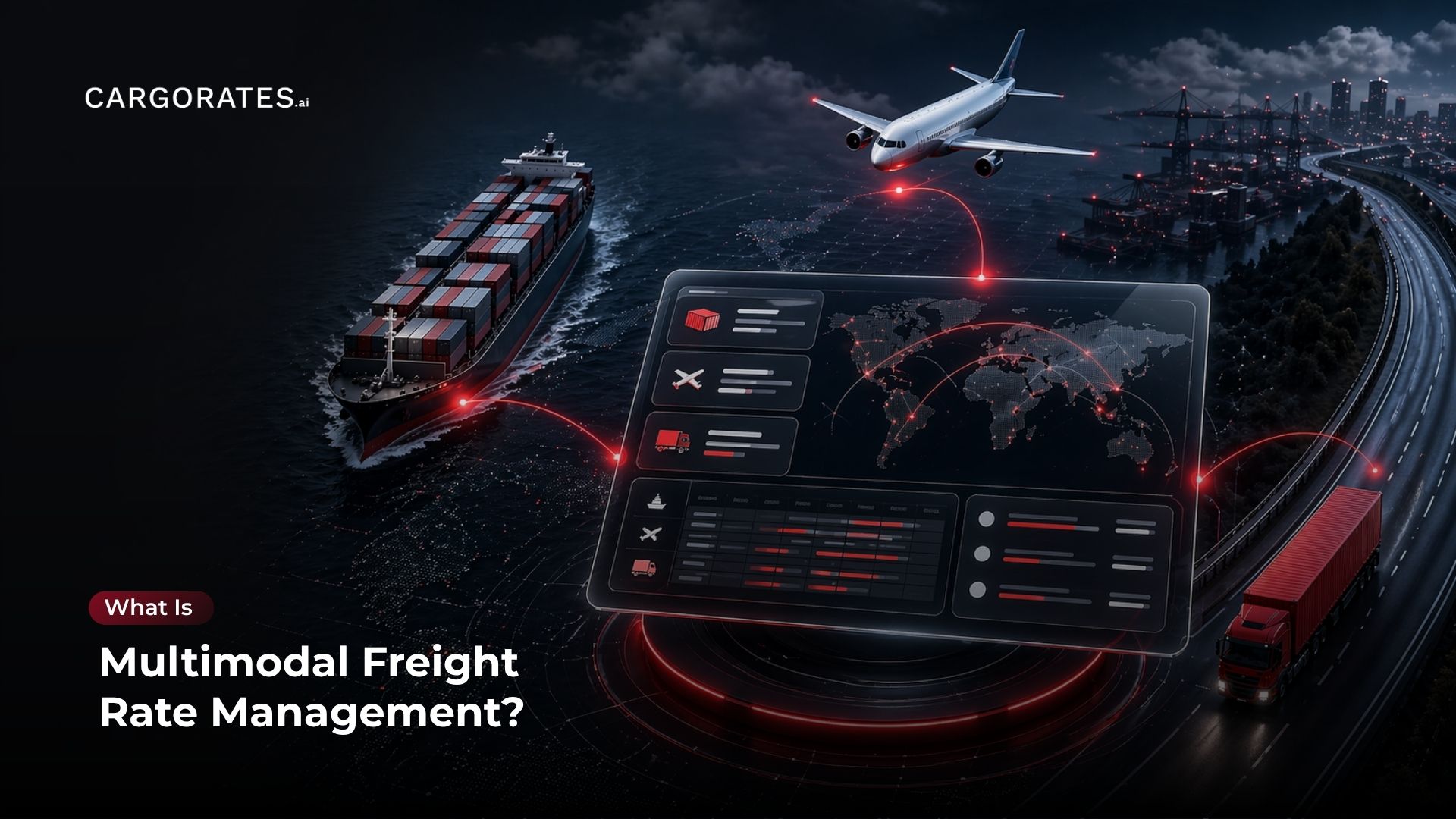
Multimodal freight rate management is the practice of centralising, governing, and querying freight rates across all transport modes, including ocean freight (FCL and LCL), air cargo, and domestic trucking, on a single platform. Instead of managing rates for each mode in separate systems, spreadsheets, or carrier portals, a multimodal rate management platform gives freight forwarders, NVOCCs, and BCOs a unified interface where all carrier rates across all modes are stored, version-controlled, surcharge-managed, and instantly queryable for quoting. Cargorates.ai delivers this unified multimodal rate management as a single platform covering ocean, air, and domestic freight for logistics teams across North America, the Middle East, Europe, and Southeast Asia.
Most freight businesses start with a primary mode. An NVOCC builds its operations around ocean freight. A regional forwarder begins with trucking. An international freight forwarder focuses on air cargo. As these businesses grow, they expand into additional modes, and with each expansion they add a new set of carrier contracts, a new rate management process, and typically a new system or set of files to manage it.
The result is a fragmented rate management infrastructure where ocean rates sit in one place, air rates in another, and trucking rates somewhere else entirely. This fragmentation is not just operationally inconvenient. It has direct commercial consequences: quoting across modes requires pulling data from multiple sources, surcharge management is inconsistent between mode-specific systems, and pricing teams cannot compare mode options for a shipper in real time without significant manual effort.
Multimodal freight rate management solves this by treating all modes as components of a single, unified rate management workflow rather than as separate operational silos.
Understanding what multimodal freight rate management covers requires being clear about what each mode involves from a rate management perspective and what makes each one operationally distinct.
Full Container Load and Less than Container Load rates, structured by trade lane, container type, carrier, and validity period. Surcharge profiles covering BAF, PSS, THC, GRI, and CAF are attached at the rate entry stage. Vessel schedules and transit times are part of the quoting data layer.
Air freight rates structured by weight break, commodity type, origin-destination pair, and carrier. Air-specific surcharges including fuel surcharges, security charges, and handling fees are managed at the rate entry stage. Transit time and routing are integral to the air rate comparison workflow.
Full Truckload and Less than Truckload rates for inland delivery, drayage, and intermodal connections. Trucking-specific surcharges including fuel surcharges and accessorial charges are managed within the same platform framework. Domestic rates are a critical component of door-to-port and port-to-door routing for ocean and air shipments.
The case for multimodal rate management starts with understanding what fragmented, mode-by-mode management actually costs in operational terms. Each problem below is the direct consequence of treating ocean, air, and trucking rates as separate workflows rather than components of a unified system.
A shipper requesting a door-to-door quote for international ocean freight needs an ocean linehaul rate, a domestic trucking rate at origin and destination, and potentially a drayage rate for port pickup and delivery. When these rates sit in separate systems, the pricing team must pull data from each one, manually combine the components, apply surcharges from separate tables for each mode, and assemble the total cost. This takes hours rather than seconds and introduces a different set of error risks at each manual step.
Each freight mode has its own surcharge structure. Ocean freight carries BAF, PSS, THC, GRI, and CAF. Air cargo carries fuel surcharges and security fees. Trucking carries fuel surcharges and accessorial charges. When each mode is managed in a separate system, surcharge profiles are maintained separately, updated on different schedules by different team members, and applied with different levels of consistency. The result is that quotes for multimodal shipments frequently have complete surcharge coverage for the primary mode and incomplete coverage for the secondary modes.
When a shipper asks whether their cargo should move by ocean or air, the forwarder needs to produce a cost and transit time comparison between modes quickly enough to be useful. If ocean rates are in one system and air rates in another, producing that comparison requires running two separate quoting processes, manually combining the outputs, and formatting a comparison response. Under time pressure, this is rarely done well. The shipper receives a recommendation rather than data, and the forwarder's ability to demonstrate market knowledge across modes is limited.
Understanding where a freight business is winning and where it is losing requires data that spans the full rate portfolio, not just one mode. When ocean, air, and trucking data are in separate systems, building any kind of cross-mode analytics requires manual data exports, consolidation in a spreadsheet, and interpretation without a structured data layer. Lane competitiveness, carrier performance, and rate trend analysis all need to be built from scratch for each mode independently, which means they rarely get built at all.
Every additional mode-specific system the forwarder uses adds another integration point with their TMS, ERP, and customer-facing tools. A forwarder using three mode-specific rate tools needs three separate data connections to maintain, three sets of API credentials to manage, and three potential failure points that can cause rate data to fall out of sync with operational systems. A single multimodal platform replaces all three with one integration that covers the entire rate portfolio.
A multimodal rate management platform works by applying the same operational framework across all freight modes. Rate storage, surcharge management, version control, quoting logic, and analytics all operate on the same data architecture regardless of whether the rate being processed is an ocean FCL contract, an air cargo weight break, or a domestic truckload rate.
All carrier rates for all modes are uploaded to a single platform. Ocean contracts are structured by trade lane, container type, carrier, and validity period. Air contracts are structured by origin-destination pair, weight break, commodity type, and carrier. Trucking rates are structured by lane, move type, and carrier. Every rate, regardless of mode, is stored in the same version-controlled repository where amendments are uploaded as new versions and previous versions are archived with their full date history. No rate file sits in an email inbox or shared drive folder waiting to be found at quoting time.
Each rate entry across every mode is associated with the applicable surcharge profile at the point of upload. Ocean rates carry their BAF tables, PSS windows, THC configurations, GRI schedules, and CAF corridor rules. Air rates carry their fuel surcharge and security fee structures. Trucking rates carry their fuel surcharge tables and accessorial rate schedules. When a quote is generated for any mode or combination of modes, all surcharges are applied automatically based on the current date, carrier, routing, and cargo type. No pricing team member manually calculates surcharges at the quoting stage for any mode.
When a quote request arrives, the platform searches all relevant rates across all applicable modes simultaneously. A door-to-door ocean quote query searches ocean carrier rates for the trade lane and domestic trucking rates for the origin and destination inland legs in a single query. A mode comparison request for a specific origin-destination pair returns ocean and air options in one view, with surcharge-inclusive totals and transit times for each, without the pricing team pulling data from separate systems. The complete, surcharge-inclusive, multi-carrier quote is ready in under 30 seconds regardless of how many modes the shipment involves.
Contracted rates are not the only relevant data point at the time of quoting. Live spot market rates for ocean freight are surfaced alongside contracted rates in the same comparison view, allowing forwarders to identify when spot rates represent better value than a contracted rate and present that information to the shipper without running a separate spot rate search. This real-time spot rate access is part of the same unified quoting interface that serves contracted ocean, air, and trucking rates, not a separate workflow.
Shipment visibility for a multimodal freight portfolio requires tracking across ocean, air, and domestic legs without switching tools. Cargorates.ai provides Track and Trace functionality that covers all freight modes, giving both the forwarding team and their shipper customers real-time visibility of shipment status across the full multimodal journey through a single interface. Shippers access this visibility directly through the branded Digital Customer Portal without needing to contact the forwarding team for status updates on any mode.
Smart Reports converts the daily quoting and shipment data from all modes into analytics dashboards that give forwarders and BCOs lane-level visibility across their full freight rate portfolio. Which ocean lanes are consistently competitive? Where are air rates creating margin compression? Which trucking corridors have the highest quote volume but the lowest win rate? These questions are answered from data the platform captures automatically, without manual exports or spreadsheet consolidation across mode-specific systems. Cross-mode analytics is a core output of the platform's unified data architecture, not an add-on module.
One of the most operationally significant benefits of unified multimodal rate management is consistent surcharge governance across all freight modes. Each mode carries its own surcharge structure, and managing them accurately requires a system that knows which surcharges apply to which mode, carrier, lane, and date combination without requiring manual lookup at the time of quoting.
In a multimodal platform, each surcharge type is attached to the relevant carrier rates at upload, specific to the mode, carrier, and applicable conditions. When a quote is generated, the platform applies the correct surcharges for each mode automatically without a team member needing to know the current BAF table for a specific carrier or the fuel surcharge tier for a specific air carrier. Surcharge completeness is a system function, not a human one, across all modes simultaneously.
Any freight business managing rates for more than one transport mode is, by definition, a multimodal rate management operation, whether or not it uses a platform built for that purpose. The question is not whether multimodal rate management applies to a given business. It is whether that business is managing its multimodal rate portfolio in a way that is operationally efficient and commercially competitive.
NVOCCs whose ocean services are complemented by domestic drayage, rail connections, or inland delivery are managing a multimodal rate portfolio even when they think of themselves primarily as ocean carriers. The drayage rate that connects a port to a shipper's warehouse is as commercially important to the total shipment cost as the ocean linehaul rate, and it needs the same level of surcharge management, version control, and quoting integration that the ocean rate receives. Keeping drayage rates in a separate spreadsheet while managing ocean contracts in a platform creates an avoidable fragmentation point at a commercially critical juncture. The capabilities that support this integrated workflow are covered in the overview of how Cargorates.ai supports NVOCCs and freight forwarders across the full rate management and quoting workflow.
An international freight forwarder offering ocean, air, and trucking services to the same shipper base is managing three distinct rate portfolios. If those portfolios are managed in three separate systems, the forwarder's ability to respond to cross-mode quote requests quickly and accurately is limited by the slowest and most manual of those three systems. A multimodal rate management platform removes this limitation by applying the same quoting infrastructure to all three modes, so a forwarder can generate a complete ocean, air, or trucking quote in the same time regardless of which mode the shipper is asking about. The operational detail of how modern freight forwarding teams structure their rate management workflow across all modes is covered in our analysis of how modern freight forwarders manage ocean freight and the platform infrastructure behind it.
A Beneficial Cargo Owner managing freight spend across ocean and air modes needs consolidated analytics across both to understand their total logistics cost structure. When ocean and air rates are managed in separate systems, the procurement team cannot build a unified view of freight spend by trade corridor that spans both modes. Rate benchmarking, carrier performance analysis, and procurement intelligence are all mode-limited when the data infrastructure is fragmented. A multimodal rate management platform gives BCO procurement teams the cross-mode visibility they need to manage total freight cost rather than mode-by-mode cost in isolation.
| Operational Area | Single-Mode (Fragmented) | Multimodal Platform (Cargorates.ai) |
|---|---|---|
| Rate storage | Separate files, portals, or tools per mode; no unified query capability | All modes centralised in one platform with consistent version control and expiry management |
| Cross-mode quoting | Requires pulling data from multiple systems, manual assembly, and separate formatting | Platform queries all applicable modes simultaneously and generates complete quote in one step |
| Surcharge management | Each mode's surcharges tracked in separate documents; inconsistent update cycles | Mode-specific surcharge profiles attached at rate upload; applied automatically per mode |
| Mode comparison for shippers | Requires running two quoting processes and manually combining outputs | Ocean and air options compared in one view with surcharge-inclusive totals and transit times |
| Spot rate access | Ocean spot rates checked on separate portals; air spot rates not integrated | Real-time spot rates for ocean surfaced alongside contracted rates in unified view |
| Shipment tracking | Different tracking tools per mode; shippers must contact team for each mode separately | Track and Trace covers all modes; shippers self-serve through Digital Customer Portal |
| Analytics | Lane performance and carrier data siloed by mode; cross-mode analysis requires manual exports | Smart Reports provides unified lane-level analytics across all modes automatically |
| System integration | Multiple integration points with TMS and ERP; one per mode-specific tool | Single EDI and API integration point covering all modes in one connection |
| Margin governance | Margin rules defined and applied per mode; inconsistent across the full quote portfolio | Pre-configured margin rules applied consistently across all modes from one governance layer |
Cargorates.ai is built as a multimodal freight rate management platform from the ground up, not as an ocean freight platform with air and trucking add-ons. The architecture that supports FCL contract management, surcharge automation, and instant quoting for ocean freight is the same architecture that supports air cargo rate management and domestic trucking rate management. There is one platform, one version control system, one surcharge management framework, and one quoting engine across all modes.
Ocean freight rates, including both FCL and LCL, are stored with full surcharge profiles covering BAF, PSS, THC, GRI, and CAF. The detailed mechanics of how FCL rates in particular are structured within the platform, including how container types, trade lane hierarchies, and validity periods are organised, are covered in the guide to FCL rate management and how to structure, store, and apply Full Container Load rates. Air cargo rates are stored with weight break structures and air-specific surcharge profiles. Domestic trucking rates are stored with lane and move type specifications and fuel surcharge tables.
All modes share the same instant quoting infrastructure. When a quote request arrives through the branded Digital Customer Portal or through the Email Response Bot, the platform searches all applicable modes simultaneously and delivers a complete response in under 30 seconds. Vessel schedules for ocean routing are integrated directly into the quoting workflow, so routing completeness is part of every ocean quote without a separate schedule lookup.
Smart Reports aggregates quoting and shipment data across all modes into lane-level dashboards that freight forwarders use for carrier performance analysis and BCO procurement teams use for freight spend governance. Track and Trace provides real-time shipment visibility across ocean, air, and domestic freight in a single interface. EDI and API integration connects the platform to TMS and ERP systems with a single integration point covering the entire multimodal rate portfolio. The broader context of how AI-powered automation underpins all of this across both the quoting and procurement workflows is explained in the guide to how AI is changing the way forwarders and BCOs manage freight rates from manual to automated.
The platform is powered by Info-X Software Technology Pvt. Ltd., a logistics technology company with over 20 years of industry experience, and was recognised by Corporate Vision as the Best AI-Powered Freight Rate Management Platform in India in 2025. It processes over 1,000 daily rate searches and serves logistics teams across North America, the Middle East, Europe, and Southeast Asia.
For the complete picture of how ocean freight rate management, which remains the largest component of the multimodal rate portfolio for most forwarders and NVOCCs, fits into the broader framework of carrier governance, contract management, and rate benchmarking, the comprehensive reference is our guide to how ocean freight rate management works across the full quoting and procurement lifecycle.
Multimodal freight rate management is the practice of centralising, governing, and querying freight rates across all transport modes, including ocean freight (FCL and LCL), air cargo, and domestic trucking, on a single platform. Instead of managing rates for each freight mode in separate systems, spreadsheets, or portals, a multimodal rate management platform gives freight forwarders, NVOCCs, and BCOs a unified interface where all carrier rates across all modes are stored, version-controlled, surcharge-managed, and instantly queryable for quoting.
Multimodal freight rate management covers ocean freight (both FCL and LCL), air cargo, and domestic trucking (including LTL and FTL). On the ocean side, it manages FCL rates by container type and trade lane, LCL rates by cargo volume and routing, and all applicable ocean surcharges including BAF, PSS, THC, GRI, and CAF. On the air side, it manages air cargo rates by weight break, commodity type, and routing with applicable air surcharges. On the domestic side, it manages trucking rates including drayage and inland delivery components.
Freight forwarders need multimodal rate management because their customers ship cargo across multiple modes, and a forwarder that manages each mode in a separate system cannot produce integrated quotes, compare mode options for a shipper, or maintain consistent rate governance across their full carrier portfolio. Without a unified platform, quoting for an ocean-plus-domestic shipment requires pulling data from multiple systems, manual calculation, and assembly by email, which is slow, error-prone, and not competitive with forwarders using integrated multimodal platforms.
In practice, multimodal freight rate management works by loading all carrier rates for every mode into a single platform, attaching mode-specific surcharge profiles at the rate entry stage, configuring margin rules at the system level, and making every rate immediately queryable by mode, trade lane, carrier, container type or weight break, and validity period. When a quote request arrives for a multimodal shipment, the platform searches all relevant rates across all modes simultaneously and generates a complete, surcharge-inclusive response without the pricing team manually pulling data from separate sources.
Unimodal freight rate management covers a single transport mode, typically ocean freight, in a dedicated system or set of files. A forwarder managing only ocean rates in one spreadsheet and air rates in a separate portal is operating two unimodal systems. Multimodal freight rate management centralises all modes on a single platform, so rates for ocean, air, and trucking are governed by the same version control, surcharge automation, and quoting logic. The operational advantage is that a forwarder can quote any mode or combination of modes without switching systems or manually combining data from multiple sources.
Cargorates.ai supports multimodal freight rate management by providing a single platform that centralises ocean (FCL and LCL), air, and domestic trucking rates. Each mode's rates are stored with mode-specific surcharge profiles, version control, and validity management. All rates are instantly queryable for quoting, and real-time spot rates are available alongside contracted rates. The platform includes live vessel schedule integration for ocean, Track and Trace across all modes, a branded Digital Customer Portal for shipper self-service, Smart Reports with mode-level analytics, and EDI and API integration with TMS and ERP systems.
Ocean freight surcharges include BAF (Bunker Adjustment Factor), PSS (Peak Season Surcharge), THC (Terminal Handling Charges), GRI (General Rate Increase), and CAF (Currency Adjustment Factor). Air cargo surcharges include fuel surcharges, security surcharges, and handling charges. Domestic trucking surcharges include fuel surcharges and accessorial charges. In a multimodal rate management platform like Cargorates.ai, each mode's surcharge profiles are attached to the applicable rate entries at upload and applied automatically when a quote is generated.
The logistics professionals who benefit most from multimodal freight rate management are NVOCCs that manage ocean, domestic drayage, and intermodal routing; freight forwarders offering ocean, air, and trucking services to a single shipper base; and BCOs managing freight spend across multiple modes and needing consolidated analytics across their full logistics cost. Any freight business managing rates for more than one transport mode in separate systems is carrying fragmentation costs that a unified multimodal platform eliminates.
See how Cargorates.ai centralises ocean, air, and trucking rates in one AI-powered platform, automates surcharge management across all modes, and delivers complete multi-carrier quotes in under 30 seconds.
Schedule a Demo